


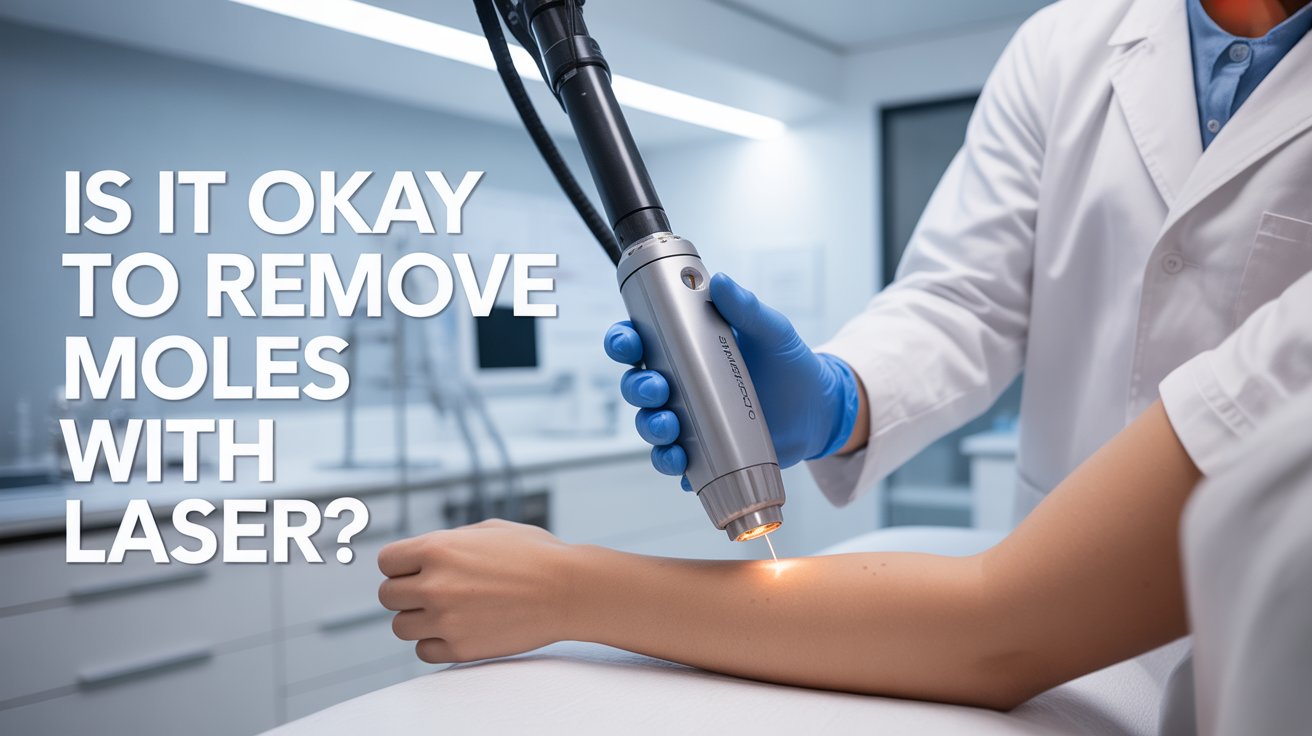
Laser mole removal has become an increasingly popular option for people who want to get rid of moles without going under the knife. It sounds straightforward — quick, non-invasive, minimal downtime. But is it okay to remove moles with laser? And more importantly, is it always the right choice for you?
The answer, as with most things in medicine, is: it depends. Laser removal can be a safe and effective option — but only for the right type of mole, assessed by the right professional, and carried out in the right clinical setting. In this guide, we’ll walk you through exactly how laser mole removal works, when it’s appropriate, when it isn’t, and what your alternatives are if laser treatment isn’t suitable for your situation.
How Does Laser Mole Removal Work?
Laser mole removal uses high-intensity light energy to target and break down the pigment (melanin) within a mole. The laser is calibrated to a specific wavelength that is absorbed by the pigmented cells, causing them to fragment and gradually fade as the skin heals.
Different laser types are used depending on the mole’s characteristics. Q-switched lasers are often used for flat, superficial moles with surface pigmentation, while Er:YAG and CO₂ lasers can achieve more complete removal in compound or deeper moles. In some cases, a combination approach delivers the best cosmetic outcome.
The procedure itself is relatively quick. The treatment area is cleaned and a local anaesthetic applied to minimise discomfort. The laser is then directed at the mole in precise, controlled pulses. Afterwards, the area may appear slightly red, and a small scab will typically form over the following days before healing.
Is Laser Mole Removal Safe?
When performed by a qualified, experienced clinician using medical-grade equipment, laser mole removal is generally considered safe. Complications such as infection, significant scarring, or burns are uncommon when the procedure is carried out correctly.
That said, there are important caveats. Laser treatment involves concentrated, high-intensity light energy, which means that eye protection for both the patient and the clinician is essential throughout. There is also a risk — however small — of pigmentation changes to the surrounding skin, particularly in individuals with darker skin tones or those who are prone to scarring.
Crucially, the safety of laser mole removal depends heavily on one thing above all else: knowing the mole is benign before any treatment takes place. This is not a step to skip or rush, and we’ll explore why in the next section.
The Most Important Question: Has the Mole Been Properly Assessed?
This is the point that separates a responsible laser mole removal procedure from a potentially dangerous one. Unlike surgical excision, laser treatment does not remove any tissue that can be sent to a laboratory for pathological analysis. There is no biopsy. The mole cells are simply destroyed in place.
This means that if a mole has any atypical or pre-cancerous features that were not identified before treatment, those findings will be lost entirely. A melanoma, for example, could be inadvertently treated with laser — with the result that no diagnosis is ever made, and no appropriate follow-up occurs.
As board-certified dermatologists note, laser treatment is appropriate only when a mole is confirmed to be benign following a thorough clinical assessment, and preferably dermoscopic examination. If there is any uncertainty whatsoever, surgical excision — with full pathological analysis of the removed tissue — is the safer and more appropriate course of action.
At The Private GP, our doctors assess each mole carefully before recommending any removal method. If you’d like to understand your options in more detail, you can book a minor surgery and joint injection consultation to discuss your individual case.
When Is Laser Mole Removal a Good Option?
Laser removal is best suited to a specific set of circumstances. It is generally most appropriate when:
- The mole is flat and superficial — laser light penetrates effectively into surface pigmentation but struggles to reach the deeper layers of raised or thick moles.
- The mole is small — larger moles may not be fully addressed in a single session, increasing the chance of incomplete removal.
- The mole is in a cosmetically sensitive area — laser is often preferred on the face, neck, or ears, where minimising scarring is a priority.
- The mole has been confirmed as benign — this is non-negotiable. Without a prior assessment ruling out anything suspicious, laser treatment is not appropriate.
- Removal is for cosmetic reasons — if the goal is simply to improve the appearance of a mole rather than to address a medical concern, laser is a reasonable consideration.
If multiple benign moles are present and you’d like to have more than one addressed, laser can also treat several moles in a single session — which can be a practical advantage over separate surgical procedures.
When Is Laser Mole Removal Not Appropriate?
There are situations where laser is simply not the right tool for the job, and where choosing it over a surgical approach could carry real risk. Laser mole removal is not recommended when:
- The mole is changing, bleeding, itching, or has irregular borders — any of these signs warrant a full assessment and, if removal is indicated, surgical excision with biopsy.
- The mole is raised or deeply pigmented — laser cannot reliably penetrate the full depth of the mole, increasing the risk of incomplete removal and regrowth.
- There is a personal or family history of melanoma or skin cancer — a higher level of vigilance and formal pathological assessment is appropriate.
- You have not had the mole professionally assessed beforehand — without prior evaluation, proceeding with any laser treatment is inadvisable.
It is also worth noting that because laser removes cells without providing a sample for analysis, a mole that was not fully treated can potentially regrow. In rare cases, a benign mole that regrows after incomplete removal can display features that resemble more concerning lesions under examination — another reason why complete, clinically supervised removal matters.
Laser vs. Surgical Mole Removal: Which Is Better?
This is one of the most common questions we encounter, and the truthful answer is that neither method is universally ‘better’ — they serve different purposes.
Laser Removal
- Non-invasive, no stitches required
- Minimal scarring, particularly on the face
- Quick procedure with short recovery time
- Best for small, flat, confirmed-benign moles
- Does not provide tissue for biopsy
- Higher risk of incomplete removal for deeper moles
Surgical Excision
- Removes the mole entirely, including deeper layers
- Tissue sent for pathological analysis — essential for any suspicious mole
- Considered the gold standard for any mole with concerning features
- Suitable for raised, larger, or potentially atypical moles
- Requires local anaesthetic and may involve stitches
- Slightly longer recovery, but reliable and complete
Our minor surgery service in Birmingham covers surgical mole removal carried out by experienced GPs in a fully clinical setting. All removed tissue is processed appropriately, giving you both peace of mind and a definitive result.
What About DIY Laser Devices?
A word of caution here. There is a growing market for at-home laser and mole removal devices, and we would strongly advise against using any of them. Without a prior professional assessment, you have no way of knowing whether a mole is safe to treat. At-home devices lack the precision and calibration of medical-grade equipment, and there is a documented risk that treating a mole at home can alter its cellular appearance — making subsequent professional assessment more difficult and potentially delaying an important diagnosis.
If you are considering mole removal for any reason, the starting point should always be a clinical consultation, not a home kit.
What Should You Do If You’re Concerned About a Mole?
The first step is always assessment — not treatment. Before any decisions are made about removal method, a qualified clinician needs to examine the mole carefully, considering its size, colour, shape, depth, and whether it has changed over time.
At The Private GP, we offer mole removal in Birmingham with a thorough assessment built into the process. We will advise you honestly on whether laser, surgical excision, or simply monitoring the mole is the most appropriate course of action for your individual situation.
If you would also like a broader review of your general health alongside your mole assessment, our full health check-up service offers a comprehensive overview from one of our experienced GPs.
The Bottom Line
So, is it okay to remove moles with laser? Yes — but with important conditions. Laser mole removal is a safe and effective option when it is used for the right type of mole, confirmed as benign by a qualified clinician, and performed using proper medical-grade equipment by an experienced professional.
It is not a shortcut to be taken lightly, and it is not appropriate for moles that are changing, suspicious, raised, or have not been properly assessed. In those situations, surgical removal with a biopsy remains the gold standard — and the approach that gives you the clearest, most reliable outcome.
If you have a mole you’d like assessed or removed, we’d encourage you not to wait. Early assessment is always straightforward, and it ensures that whatever approach is taken is the right one for you. Get in touch with The Private GP to arrange your consultation.