


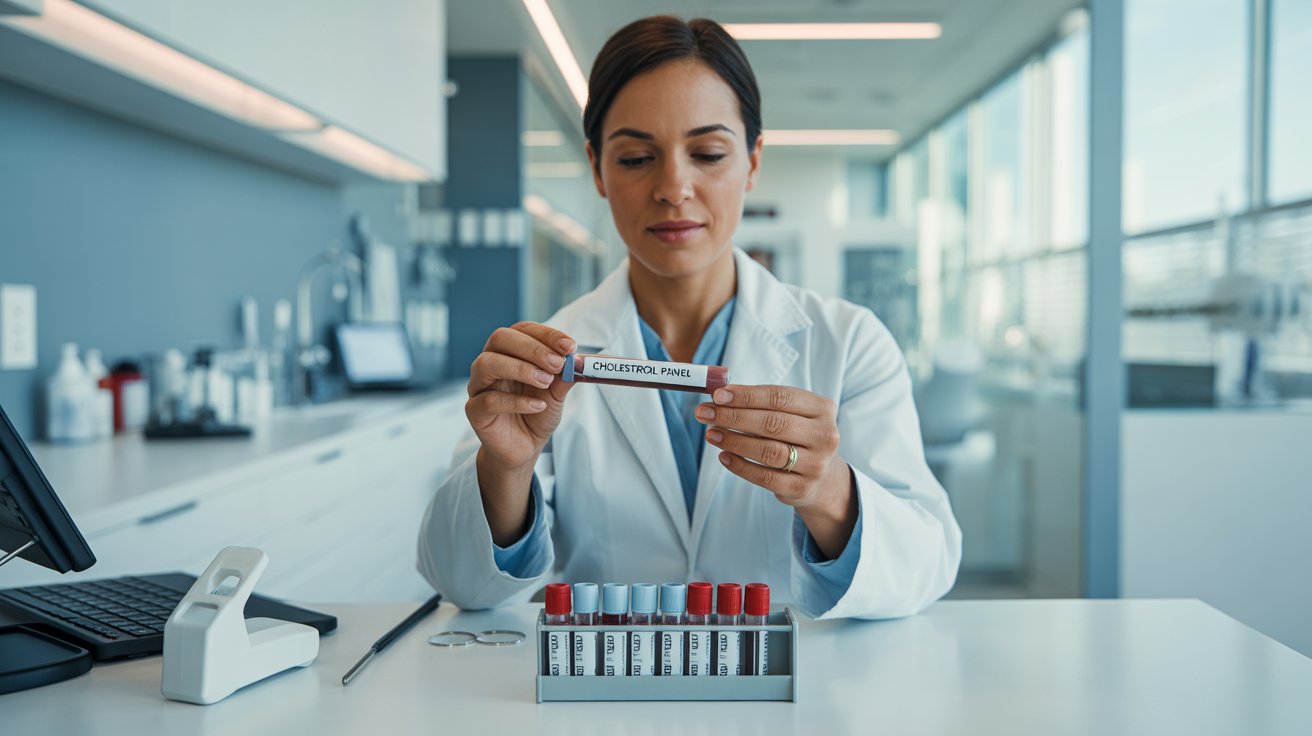
High cholesterol affects around 40% of adults in the UK, and the vast majority have no idea — because it produces no symptoms. The only reliable way to know your cholesterol level is through a blood test. If you have been asking where to get a cholesterol test, you have more options than you might think: your NHS GP, a community pharmacy, an at-home kit, or a private GP clinic, each with different costs, speed, and levels of clinical support. This guide explains each option honestly, so you can choose what is right for you.
Option 1: Your NHS GP
Your NHS GP is the most clinically comprehensive route to a cholesterol test. A GP will take a full blood sample from the arm — a venous draw — which goes to an accredited NHS laboratory for processing. The result includes a full fasting lipid profile: total cholesterol, LDL (low-density lipoprotein), HDL (high-density lipoprotein), non-HDL cholesterol, and triglycerides. Crucially, the result is reviewed in the context of your overall cardiovascular risk, medical history, and any medications you are taking — not just as a number in isolation.
Who should see their NHS GP?
Your NHS GP should be your first port of call if you have symptoms that concern you, a significant family history of cardiovascular disease or familial hypercholesterolaemia, existing conditions such as diabetes or hypertension, or if you are already on cholesterol-lowering medication and need a monitoring test. Your GP can also calculate your ten-year cardiovascular risk using the QRISK3 tool — combining your cholesterol result with blood pressure, BMI, age, smoking status, and other factors to give you a meaningful picture of your actual heart attack and stroke risk, not just a single cholesterol number.
The NHS Health Check
If you are aged 40 to 74 and have not been diagnosed with cardiovascular disease, diabetes, or kidney disease, you are entitled to a free NHS Health Check every five years. This includes a cholesterol test, blood pressure, BMI, and a cardiovascular risk score — all provided at no cost at your GP surgery or, in some areas, at a community pharmacy. If you are in this age group and have not had an NHS Health Check, requesting one is the single most cost-effective starting point for understanding your cardiovascular health. Contact your GP surgery to arrange it.
Limitations of the NHS GP route
The main limitation of the NHS GP route is access and timing. NHS GP appointments for non-urgent matters can involve waits of one to three weeks in many parts of England. Cholesterol test results typically take three to five working days to return from the NHS laboratory. If you want a same-day or next-day result, or if you cannot get a timely NHS appointment, an alternative route is worth considering.
Option 2: Community Pharmacy
Community pharmacies across the UK offer cholesterol testing as a walk-in or booked service, with no GP referral required. Most pharmacy cholesterol tests use a finger-prick capillary blood sample rather than a venous blood draw, producing a result in minutes using a portable analyser.
What a Pharmacy Cholesterol Test covers
A standard pharmacy cholesterol check typically measures total cholesterol, LDL, HDL, and triglycerides, with an immediate result and a brief consultation with the pharmacist to explain what the numbers mean. Some pharmacies — including those participating in the NHS Community Pharmacy Blood Pressure Check Service and newer rapid lipid testing programmes such as the HealthTab system piloted by NHS North East London in partnership with Barts Health NHS Trust — also calculate a QRISK3 cardiovascular risk score alongside the cholesterol result, providing a richer clinical picture. National pharmacy chains including Boots (via their in-store health services), LloydsPharmacy, and independent pharmacy networks such as Pharmacy+Health offer cholesterol testing with results available within 48 hours where a venous sample is sent to a laboratory.
Pharmacy Cholesterol Test Costs
Pharmacy cholesterol tests are typically priced between £15 and £40 for a basic finger-prick test with immediate results. Venous blood draw tests processed by an external laboratory — which offer greater accuracy and a more complete lipid panel — are generally £30 to £60 at pharmacies, with results in 24 to 48 hours. Some pharmacies offer the NHS Community Pharmacy cholesterol check free of charge for eligible patients.
Limitations of the Pharmacy Route
Finger-prick capillary tests, while convenient, are less accurate than a fasting venous blood draw for several reasons: the blood sample is smaller, the results are produced by a portable point-of-care analyser rather than an accredited laboratory, and the test is typically non-fasting, meaning triglyceride results in particular may not reflect your true baseline. Heart UK — the UK’s leading cholesterol charity — recommends professional testing over home or walk-in methods for this reason.
Option 3: At-Home Cholesterol Test Kits
At-home cholesterol test kits are available from pharmacies, supermarkets, and online retailers, including Boots, LloydsPharmacy Online Doctor, and dedicated health testing companies. Most involve a finger-prick blood collection at home, with the sample posted to a laboratory in a prepaid envelope and results returned digitally within two to five days.
What at-home kits include
The better at-home kits — including the Boots MyHealthChecked Cholesterol Profile and the LloydsPharmacy Online Doctor home blood test — measure the full lipid panel: total cholesterol, LDL, HDL, and triglycerides, with results reviewed by a clinician before delivery to a secure online dashboard. Some also flag whether results are within normal range and provide basic lifestyle guidance.
Costs and availability
At-home cholesterol test kits typically cost £20 to £50 depending on the provider and the breadth of the panel.
Limitations of at-home testing
At-home finger-prick tests have the same accuracy limitations as pharmacy point-of-care tests — the sample is small, and self-collection introduces variability in technique that can affect results. More importantly, a test result delivered to a digital dashboard with no clinical consultation attached to it is of limited value without someone to interpret what it means for your health specifically. Heart UK does not recommend home sampling as the primary route to cholesterol testing for this reason. If your result is elevated, abnormal, or you simply do not know what to do with the number, you still need to see a GP. The at-home kit is a useful screening tool for those who are curious and proactive; it is not a substitute for a clinical cholesterol assessment.
Option 4: Private GP Clinic
A private GP clinic is the most clinically comprehensive route to a cholesterol test outside of the NHS — and in many cases the fastest. At The Private GP in Birmingham, a private cholesterol blood test provides a full fasting venous lipid profile — total cholesterol, LDL, HDL, non-HDL, and triglycerides — processed by an accredited laboratory, with results reviewed face-to-face with Dr Israar Ul-Haq, our GMC-registered Medical Director. Same-day appointments are available.
What a Private GP Cholesterol Test includes
- Full fasting venous lipid profile: Total cholesterol, LDL, HDL, non-HDL cholesterol, and triglycerides — the complete picture required for a meaningful cardiovascular risk assessment
- Accredited laboratory processing: Your sample is processed by an accredited laboratory rather than a portable point-of-care device, giving a higher level of analytical accuracy
- GP results review: Your results are discussed in a face-to-face consultation with a GMC-registered GP who can contextualise the findings within your full health history, calculate your cardiovascular risk, and explain what the numbers mean for you specifically
- Further investigation if required: If your results indicate that additional assessment is needed — blood pressure monitoring, diabetes screening, liver function, or specialist referral — your GP can arrange this immediately rather than redirecting you elsewhere
When a Private GP Cholesterol Test is the right choice
A private GP cholesterol test is particularly valuable if you cannot get a timely NHS appointment and want a result and clinical advice promptly; if you have a family history of high cholesterol or premature cardiovascular disease and want a thorough assessment; if you are already on a statin and want your monitoring blood tests reviewed with clinical input; if you have other risk factors — diabetes, hypertension, obesity — that make a comprehensive cardiovascular assessment important; or if you have had an abnormal result from a pharmacy or at-home test and want it properly investigated.
Cost of a Private GP Cholesterol Test
At The Private GP in Birmingham, private cholesterol blood testing is available with same-day appointments and same-day results where clinically urgent. Contact us directly for current pricing. If you would like your cholesterol assessed as part of a broader metabolic health review — alongside thyroid function, HbA1c, kidney and liver function, and full blood count — our comprehensive private blood test service covers all of these in a single appointment, with a full clinical review by Dr Ul-Haq.
Comparing Your Options at a Glance
- NHS GP: Free, most clinically comprehensive, full lipid panel from venous draw, GP results review included — but can involve a wait of one to three weeks for an appointment and three to five days for results
- NHS Health Check (age 40–74): Free, includes cholesterol test and cardiovascular risk score, available every five years — limited to eligible age group and not available for more frequent monitoring
- Community pharmacy: £15–£60, walk-in or booked, fast results (finger-prick in minutes or venous send-away in 24–48 hours), no referral needed — less accurate than venous draw, no GP consultation or prescribing
- At-home kit: £20–£50, convenient, results in 2–5 days — same accuracy limitations as finger-prick tests, no clinical consultation included, results require a GP for interpretation and action
A patient who came to The Private GP in Birmingham — a woman in her early forties with a strong family history of heart disease — had been trying to book a cholesterol test at her NHS surgery for six weeks without success. She had purchased a home kit in the interim, which gave her a total cholesterol reading of 6.8 mmol/L. She had no idea whether this was seriously abnormal, borderline, or understandable given her age and family history.
A same-day appointment at The Private GP provided a full fasting venous cholesterol panel alongside an HbA1c, thyroid function, and blood pressure assessment. Her LDL was 4.6 mmol/L — elevated. Her ten-year cardiovascular risk, calculated using QRISK3, was significantly raised given her family history and age. Dr Ul-Haq discussed the findings, initiated a statin, and arranged a follow-up monitoring test three months later. The home kit had given her a number; the private GP appointment gave her a diagnosis and a plan.
Who Should Get a Cholesterol Test?
Heart UK and NICE recommend cholesterol testing for all adults from age 40 as part of routine cardiovascular risk assessment. Testing should be considered earlier if:
- A parent, sibling, or child has had high cholesterol or a heart attack before the age of 60
- You have familial hypercholesterolaemia (FH) in the family — children of those with FH should be tested by age 10
- You have diabetes, hypertension, obesity, or chronic kidney disease
- You smoke, are physically inactive, or have a diet high in saturated fat
- You are a woman over 45 or a man over 35 with any cardiovascular risk factor
- You have not had a cholesterol test in the past five years
If you are in Birmingham and ready to find out your cholesterol level with a clear clinical result and the support of a GMC-registered GP, book a private cholesterol test or a face-to-face GP consultation at The Private GP today. Same-day appointments are available, no referral required.
Frequently Asked Questions
- Where can I get a cholesterol test in the UK?
You can get a cholesterol test through your NHS GP (free, most clinically comprehensive), at a community pharmacy (£15–£60, walk-in, no referral needed), via an at-home finger-prick kit (£20–£50, results in 2–5 days), or at a private GP clinic. In Birmingham, The Private GP offers a same-day private cholesterol blood test with a full fasting venous lipid panel, accredited laboratory processing, and face-to-face GP results review — no referral required.
- Can I get a free cholesterol test in the UK?
Yes — if you are aged 40 to 74 and have not been diagnosed with cardiovascular disease, diabetes, or kidney disease, you are entitled to a free NHS Health Check every five years, which includes a cholesterol test. Your NHS GP can also request a cholesterol test if you have relevant risk factors or symptoms. Community pharmacies in some areas offer free cholesterol checks for eligible patients. If you do not qualify for a free test or cannot access one promptly, a private cholesterol test is the most direct alternative.
- Is a pharmacy cholesterol test accurate?
Pharmacy finger-prick tests provide a useful screening indication but are less accurate than a fasting venous blood draw processed by an accredited laboratory. Factors including non-fasting status, small sample volume, and the portable analyser used can all affect result accuracy — particularly for triglycerides. Heart UK does not recommend finger-prick or home testing as the primary method of cholesterol assessment. For a clinically reliable result, a fasting venous blood test — available at your NHS GP or private GP clinic — is the gold standard.
- Do I need to fast before a cholesterol test?
For a full fasting lipid profile — which is the most clinically complete cholesterol test — a fast of 9 to 12 hours is recommended to ensure accurate triglyceride results. Total cholesterol and LDL values are not significantly affected by fasting status, but triglycerides are. Pharmacy finger-prick tests and some at-home kits are typically non-fasting. At The Private GP in Birmingham, cholesterol blood tests are conducted as fasting venous draws with morning appointments to make preparation as straightforward as possible. You will receive clear preparation instructions when you book.
- What does a cholesterol test measure?
A full cholesterol blood test — also called a lipid profile or lipid panel — measures total cholesterol, LDL (low-density lipoprotein, often called ‘bad’ cholesterol), HDL (high-density lipoprotein, often called ‘good’ cholesterol), non-HDL cholesterol, and triglycerides. The ratio of total cholesterol to HDL is also calculated and used in cardiovascular risk assessment. In a GP-led assessment, these values are interpreted alongside your blood pressure, age, sex, BMI, smoking status, family history, and other clinical factors to calculate your overall ten-year cardiovascular risk — a more meaningful guide to your actual health than any single number in isolation.