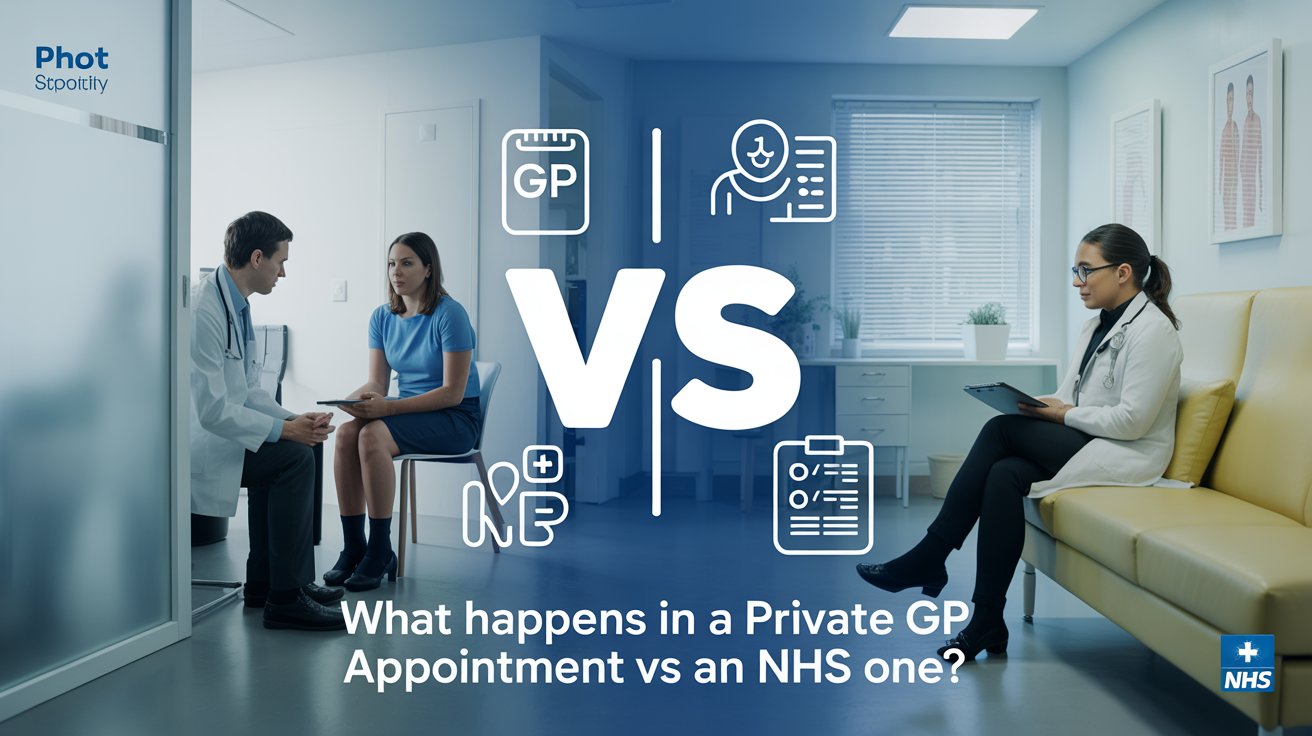
Here’s the reworded version with the word removed throughout, ready to paste into WordPress:
Are Private GPs as Qualified as NHS GPs?
Whether you have spent weeks trying to get a routine NHS appointment or simply want to understand your options before spending money, knowing the practical differences between a private and NHS GP appointment helps you make a genuinely informed decision.
The doctors are comparably qualified. What differs is the experience — the timing, the length of the appointment, what can be done on the day, and what happens next. This guide covers the differences honestly, without dismissing the NHS or overselling private care.
Yes. Both NHS and private GPs are fully qualified medical doctors who have completed the same undergraduate medical degree, foundation training, and speciality training in general practice. Qualification is not what distinguishes a private GP from an NHS one.
The General Medical Council requires all doctors practising medicine in the UK — whether NHS or private — to be registered and hold a valid licence to practise. Without GMC registration and a current licence, a doctor cannot legally see patients in the UK in any setting. Private clinics regulated by the Care Quality Commission are subject to the same inspection standards as NHS practices.
The clinical training pathway for GPs is the same regardless of whether a doctor subsequently works in NHS or private practice. The regulatory standard, authority to issue medication, and scope of clinical practice are identical. A private GP can diagnose, issue medication, refer, and order investigations with precisely the same clinical authority as an NHS GP.
How Do You Access Each One?
The access experience is one of the most significant practical differences between NHS and private GP care — and it is where the two diverge most sharply in 2026.
Accessing an NHS GP requires being registered with a practice. You contact the surgery by phone or online system, request an appointment, and are allocated a slot based on availability and clinical urgency. Same-day urgent slots exist at most practices but are limited and typically released at 8am. For non-urgent concerns, waits of one to three weeks are common across England.
The NHS confirms that GP practices are required to offer a range of appointment types including same-day urgent care, routine bookable appointments, and online consultation pathways. In practice, the availability of each varies considerably between practices and regions.
Accessing a private GP does not require registration or a referral. You book directly — by phone or online — and appointments are typically available the same day or next day. Video consultations remove the need to travel entirely. There is no 8am rush, no waiting list, and no need to explain your urgency to a receptionist before being assessed by a clinician.
What Happens During the Appointment?
The clinical scope of what both types of GP can do is essentially the same — the practical difference lies in how much time is available to do it.
Both NHS and private GPs can examine you, take a full clinical history, make a diagnosis, issue medication, refer you to specialists, request blood tests and other investigations, issue sick notes, and provide ongoing clinical management. There is no clinical capability that private GPs possess that NHS GPs do not — both are working within the same scope of medical practice.
The meaningful difference is appointment length. NHS GP consultations are typically ten minutes. This is sufficient for many straightforward presentations — a chest infection, a repeat medication request, a simple referral — but it leaves little room for complex or multi-system presentations, thorough examination, or detailed discussion of test results.
Private GP appointments are generally longer — typically 20 to 30 minutes, and sometimes more for comprehensive assessments. The additional time allows the GP to take a more thorough history, perform a more detailed examination, discuss findings in context, explain the reasoning behind any recommendations, and address more than one concern in a single visit.
For patients with several interrelated symptoms — fatigue, weight change, and mood changes, for example — the difference between ten and twenty minutes is the difference between a focused single-concern assessment and a consultation that can meaningfully explore the full clinical picture.
What About Medication and Referrals?
Both NHS and private GPs can issue medication and refer patients to specialists. The practical differences lie in cost and speed.
Medication. An NHS medication charge is £9.90 per item in England, or nothing if you are exempt (under 16, over 60, pregnant, or hold a medical exemption certificate, amongst other qualifying criteria). Medication issued privately is charged at the full cost of the drug plus a dispensing fee at the pharmacy. For some medications — particularly those available over the counter or at low cost — the private price can be comparable to or cheaper than the NHS charge. For others, particularly branded or specialist medications, the cost may be considerably higher.
Referrals. Both NHS and private GPs can refer you to NHS specialists via the NHS e-Referral system, or to private consultants for faster access. An NHS referral to a specialist typically involves a wait — the elective waiting list in England currently stands at over 7 million cases. A private referral can often result in a specialist appointment within days. Importantly, a referral from a private GP carries exactly the same clinical weight as one from an NHS GP — consultants in both settings accept referrals from either.
What Can a Private GP Offer That an NHS GP Cannot?
The differences between private and NHS GP care are not about clinical qualification — they are about access, time, and what is available on the day of your appointment.
Same-day access without the 8am rush. At The Private GP, a private GP consultation is available the same day, seven days a week, with no waiting list and no need to call at a specific time. For patients with time-sensitive concerns — symptoms that are worsening, a referral needed urgently, or medication running out — this removes a genuinely significant barrier.
Longer appointments. Private appointments give the GP the time to do the consultation properly. A thorough history, a full examination, and a clear explanation of findings and next steps — without the pressure of a ten-minute slot.
On-site diagnostics with same-day results. At The Private GP, investigations including an ECG heart health check-up and blood tests are available on site, with results reviewed by the GP at the same appointment or within one to three working days. On the NHS, investigations are typically requested at one appointment and results reviewed at a separate follow-up.
Health checks not available on the NHS. The NHS Health Check is a cardiovascular risk screen offered every five years from the age of 40. A private full health check-up at The Private GP covers a significantly broader range of markers — including ECG, full blood panel, thyroid function, and a GP consultation — available at any age and at any frequency.
Access to medications not routinely available on the NHS. Some treatments are available privately that NHS primary care does not routinely offer — either because they fall outside NHS clinical criteria or because they require a clinical assessment that the NHS pathway does not accommodate promptly. A private GP can assess suitability and issue medication where clinically appropriate.
When Is the NHS the Better Choice?
A private GP appointment is not the right answer for every situation — and being clear about this matters.
The NHS provides comprehensive, free care across the full spectrum of general practice — including management of long-term conditions, maternity care, mental health support, cancer referrals, paediatric care, and access to the full multi-disciplinary NHS pathway. For conditions requiring ongoing specialist involvement, hospital treatment, complex surgery, or multi-agency coordination, the NHS is irreplaceable.
For genuine emergencies — chest pain, signs of stroke, serious injury, sudden severe illness — always call 999 or go to A&E. A private GP clinic is not an emergency service and is not equipped to manage acute life-threatening presentations.
For patients with long-term conditions such as type 2 diabetes, hypertension, or heart disease, the NHS provides structured annual reviews, monitoring, and access to specialist teams that private primary care does not replicate. Private GP care works best as a complement to NHS care, not as a replacement for it.
The most effective approach for most people is to use both — the NHS for ongoing management, complex pathways, and emergency care, and a private GP for prompt access, thorough health assessments, and time-sensitive concerns that cannot wait.
Frequently Asked Questions
Do private GPs have access to your NHS medical records?
Not automatically. With your consent, your private GP can request a summary of your NHS records, and you can bring a printed summary or list of current medications to your appointment. At The Private GP, we take a full clinical history at your first appointment.
Can a private GP refer me to an NHS specialist?
Yes. A referral from a private GP carries the same clinical weight as one from an NHS GP. Your private GP can refer you into the NHS e-Referral system or to a private consultant, depending on your preference and clinical need.
Is medication issued privately more expensive than on the NHS?
It depends on the medication. The private issuing fee at The Private GP is £35. The medication itself is charged at full cost at the pharmacy, which for some drugs is cheaper than the £9.90 NHS charge and for others is higher. Your GP can advise at the appointment.
Do I need to tell my NHS GP I have seen a private GP?
It is good practice to inform your NHS GP, particularly if you have been started on new medication or received a diagnosis. This ensures your NHS records are up to date and avoids any duplication or conflict in your ongoing care.
Is a private GP appointment worth the cost?
For non-urgent concerns that can wait, the NHS is free and entirely appropriate. For time-sensitive symptoms, a referral needed promptly, a health check you want without delay, or a concern you want thoroughly assessed in a single appointment, the value of same-day access and longer consultation time is real and practical.