

TL;DR: Tourists in the UK can access antibiotics through several routes: a pharmacy under the Pharmacy First scheme (for seven specific conditions), a private GP appointment, an NHS walk-in or urgent treatment centre, or NHS 111 for advice and onward referral. Antibiotics are never given simply on request — a clinician must assess you and judge them clinically appropriate, and many common illnesses are viral and will not be treated with antibiotics regardless of how you access care or whether you pay privately.
Feeling unwell on holiday is disorientating enough without also trying to work out an unfamiliar healthcare system. It is worth knowing upfront that no route described here means simply asking for antibiotics and receiving them — every option still involves a proper clinical assessment first, by a pharmacist, GP, or other qualified prescriber.
Can Tourists Get Antibiotics in the UK?
Yes, but only following an assessment by a qualified clinician who judges that antibiotics are genuinely clinically appropriate for your specific symptoms. Being a tourist does not change this process in any way — it only affects whether your care is free or something you need to pay for.
NHS guidance for visitors from abroad confirms that you can ask a local pharmacist for advice about many common minor illnesses, or make an appointment with a GP if you are feeling unwell and it is not an emergency. You will need to pay for some things, such as prescriptions, in the same way that people who live in England do. The exact rules on charging can also differ depending on which part of the UK you are visiting, since Scotland, Wales, and Northern Ireland each set their own arrangements for visitors.
The underlying principle is the same regardless of where you are from or how you are paying: a clinician assesses your symptoms, and only prescribes antibiotics if they conclude this is the right and safe course of action.
Option 1 — Visit a Pharmacy Under Pharmacy First
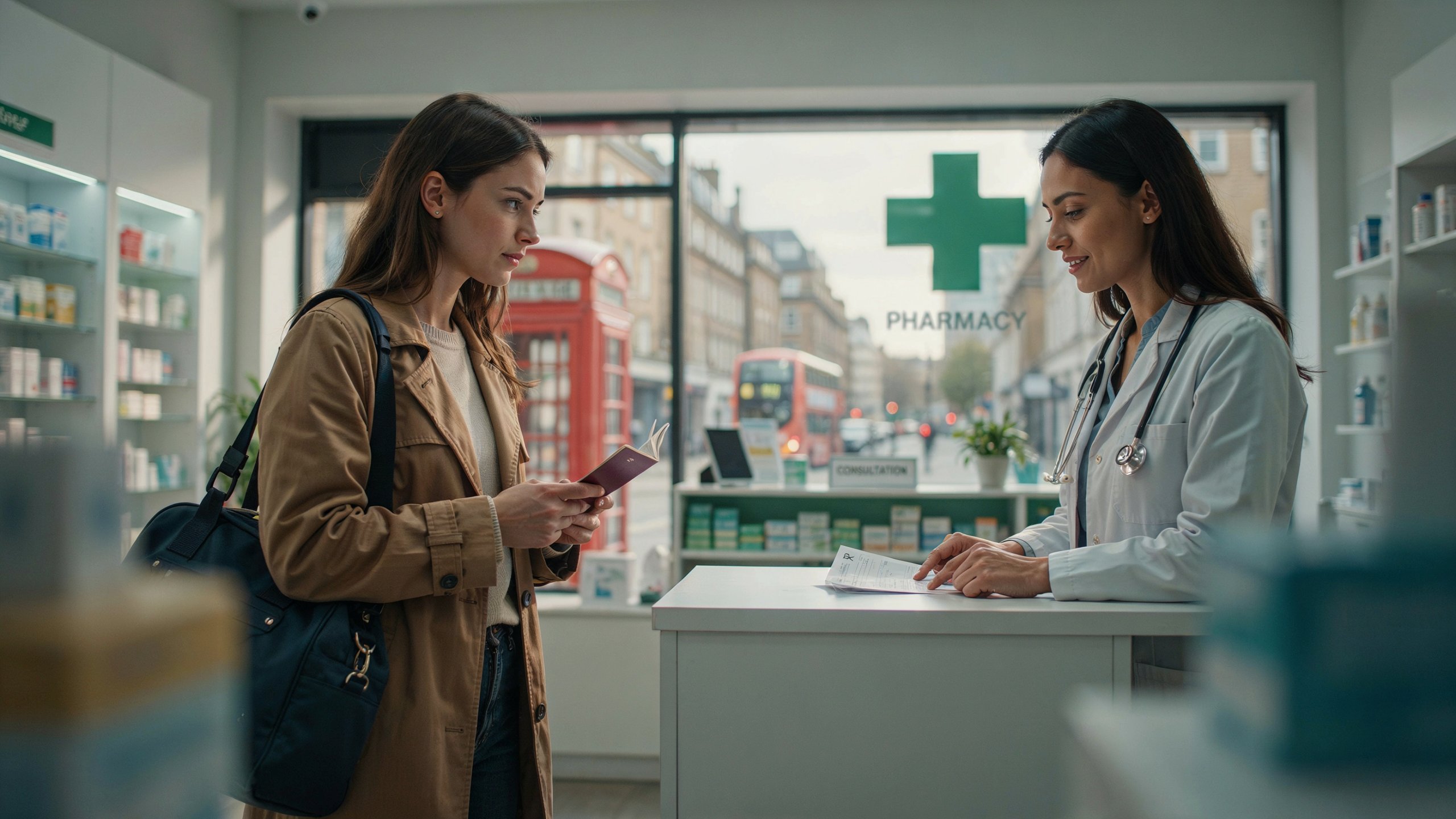
For a specific set of common conditions, a high street pharmacy can assess you and supply antibiotics directly, without needing a GP appointment at all.
The Pharmacy First scheme, launched by the government and NHS England in January 2024, allows community pharmacists across England to supply prescription-only medicines, including antibiotics where clinically appropriate, for seven common conditions: sinusitis, an infected insect bite, impetigo, shingles, and uncomplicated urinary tract infections in women, along with earache and sore throat for the relevant age groups.
Healthwatch confirms earache treatment under this scheme applies to patients aged one and over, and that you can simply walk into a participating pharmacy and ask for a private consultation, or in some cases access it virtually by phone or video. The pharmacist will ask questions and may carry out a brief examination before deciding whether a prescription is appropriate. You do not need to be registered with a GP practice to use this service, which makes it a genuinely practical first option for visitors.
Standard NHS prescription charges still apply if you are prescribed a medicine under this scheme and are not otherwise exempt. Pharmacy First is an England-specific scheme, so if you are visiting Scotland, Wales, or Northern Ireland, check what the equivalent local arrangements are, as they differ from nation to nation.
Option 2 — See an NHS GP or Use NHS 111
For symptoms that fall outside the seven Pharmacy First conditions, or that you simply want a doctor to assess directly, NHS general practice and NHS 111 remain available to visitors.
NHS guidance confirms that you can make an appointment with a GP if you are feeling unwell and it is not an emergency, though it remains up to the individual GP practice to decide whether they will accept you as a patient, particularly if you are visiting only briefly. Some practices will see visitors as a temporary patient for the duration of their stay.
NHS 111 is available free to anyone in the UK, including tourists, for non-emergency medical advice, day or night. They can assess your symptoms over the phone or online and, where appropriate, direct you to a pharmacy, arrange an out-of-hours GP appointment, or advise you to attend an urgent treatment centre if your GP practice is closed and your situation needs more prompt attention than waiting for routine hours.
What you are charged, if anything, depends on the specific service and your circumstances. Whether you are entitled to free NHS care as a visitor is a separate question from whether you can access care at all — you generally can access these services, but you should be prepared that some elements, including prescriptions, will involve a charge.
Option 3 — See a Private GP
For visitors who want speed and certainty without navigating NHS registration questions, a private GP consultation is often the most straightforward option.
Private GP services do not require any prior registration or referral, and most offer same-day appointments, either in person or by video. This removes any uncertainty about whether a particular NHS practice will accept you as a visitor, and means you can typically be seen within hours rather than days.
The consultation fee is paid directly to the clinic. If antibiotics or any other medication are prescribed, this is issued as a private prescription, and you then pay the pharmacy the actual cost of the medication itself, rather than the standard NHS prescription charge. This two-part cost structure — the consultation fee, and then the separate cost of the medicine at the pharmacy — is worth understanding before you book, so there are no surprises.
For a short-stay visitor who wants a prompt, straightforward assessment without dealing with NHS registration processes, a private GP consultation is frequently the most practical route.
Why You Won’t Always Be Given Antibiotics — Even If You Ask
This is genuinely important to understand, because it affects every route described above equally, regardless of whether you are accessing NHS or private care.
UK clinicians, whether GPs, pharmacists, or other prescribers, follow national guidelines, primarily from NICE, that restrict antibiotic prescribing specifically to situations where a bacterial infection is present and antibiotics will genuinely help. Colds, flu, and most coughs are caused by viruses, and antibiotics have no effect on viral infections whatsoever. A responsible clinician will not prescribe antibiotics for these conditions, no matter how the consultation is accessed or who is paying for it.
This caution exists because of antimicrobial resistance — bacteria becoming progressively less responsive to antibiotics the more these medicines are used, including when used unnecessarily. Taking antibiotics you do not need carries its own direct risks too, including side effects and disruption to your gut bacteria, on top of contributing to a wider public health problem.
In some cases, a clinician may offer what is called a delayed or back-up prescription — giving you the prescription but advising you to wait a few days to see whether your symptoms improve on their own first, only filling it if they do not. This is a genuinely sensible middle ground in situations where a bacterial cause is possible but not yet clear, and it is worth understanding this is a deliberate clinical strategy, not a sign of being fobbed off.
What to Bring and What to Expect at Your Appointment
A few practical preparations make any of these routes considerably smoother.
Bring photo identification and, if you have travel insurance, your policy details, since some clinics and pharmacies may ask for this, particularly for private care. Have a clear, brief list ready of your current symptoms, how long you have had them, any medications you are currently taking, and any known allergies, particularly to antibiotics themselves.
If you are paying privately, be prepared to pay at the time of your appointment, either online when booking or in person afterwards, depending on how the specific clinic operates.
It is worth knowing that UK pharmacies generally cannot simply dispense against a foreign prescription. If you have run out of medication you take regularly for an existing condition, you will usually need a UK-based prescriber to assess you and issue a fresh, UK-valid prescription, rather than having your original prescription from home directly honoured at a UK pharmacy.
Frequently Asked Questions
Can I just ask a pharmacist for antibiotics without seeing a doctor?
Not simply by asking. Under the Pharmacy First scheme, a pharmacist can assess you for seven specific conditions and prescribe antibiotics if clinically appropriate, but this still requires a proper consultation and clinical judgement, not a direct request.
Will my foreign prescription be accepted at a UK pharmacy?
Generally, no. UK pharmacies typically cannot dispense against a prescription issued outside the UK. If you need ongoing medication, a UK-based prescriber usually needs to assess you and issue a new, UK-valid prescription.
Is emergency care free for tourists in the UK?
Initial emergency treatment at A&E is generally provided regardless of where you are from. However, what counts as chargeable beyond that initial emergency care can vary, so it is worth checking your specific situation, particularly for any follow-up or non-emergency treatment.
Do I need travel insurance to see a private GP in the UK?
No, travel insurance is not required to book a private GP appointment, as you can simply pay for the consultation yourself. However, having travel insurance may allow you to claim back some or all of the cost afterwards, depending on your specific policy.
What if I need antibiotics urgently outside normal opening hours?
Call NHS 111 for advice at any time, day or night — this service is free and available to visitors as well as residents. They can direct you to an out-of-hours GP service or an urgent treatment centre if your situation needs prompt attention outside normal hours.