


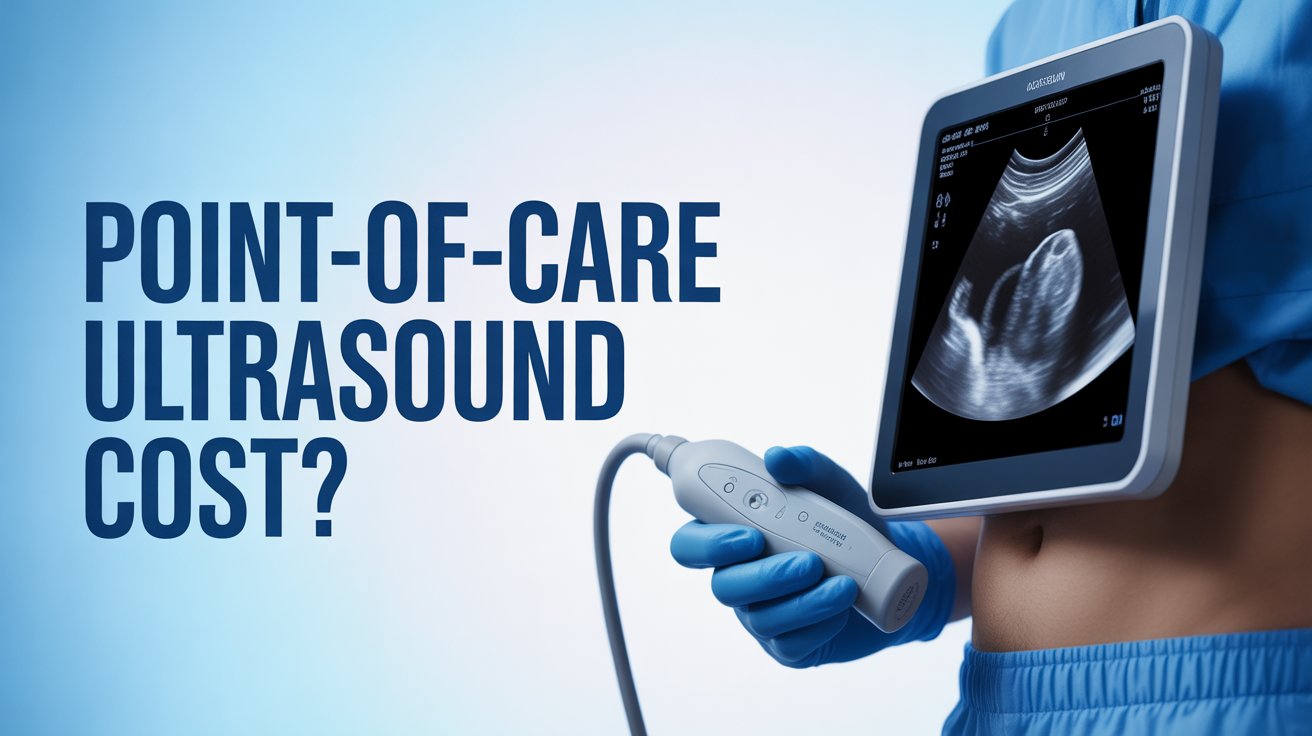
Most people are familiar with ultrasound scans from hospital imaging departments — the kind where you book a separate appointment, travel to a radiology unit, and wait days or weeks for a report. Point of care ultrasound is something quite different. It is a targeted, real-time scan performed by your GP during the consultation itself, using a portable handheld device, to answer a specific clinical question on the spot.
At The Private GP in Birmingham, a POCUS appointment costs £50. Here is everything you need to know about what it involves and whether it is right for you.
How Much Does a Point of Care Ultrasound Cost in the UK?
At The Private GP in Birmingham, a point of care ultrasound costs £50. The scan is performed by your GP during the consultation and results are discussed with you immediately — no separate imaging appointment, no waiting for a radiologist’s report, no additional booking required.
No referral from your NHS GP is needed. You can book a private GP consultation directly, and if POCUS is appropriate for your clinical question, it can be performed at the same appointment.
What Is a Point of Care Ultrasound?
Point of care ultrasound is a bedside ultrasound scan performed and interpreted by the clinician in real time, during the patient’s consultation. It is not sent away for reporting — the GP performs the scan and assesses the images immediately, in direct correlation with your symptoms.
Research published in the British Journal of General Practice defines POCUS as an ultrasound examination performed and interpreted in real time during a patient’s consultation, and describes it as the “stethoscope of the future.” The introduction of POCUS in general practice can improve diagnostic pathways, leading to prompter referral and treatment, and thereby contributing to better patient outcomes.
The key principle behind POCUS is that it answers focused, binary clinical questions — is there fluid present or not? Does this structure appear normal? Is there an abnormality that requires further investigation? It is not designed to replace a comprehensive departmental ultrasound, but to provide immediate, targeted clinical information at the point of care.
Portable ultrasound devices are becoming smaller, more sensitive, and more affordable, making POCUS increasingly accessible in primary care settings — including private GP clinics. The RCGP now has a dedicated POCUS special interest group, reflecting the growing role of this technology in UK general practice.
What Can a Point of Care Ultrasound Show?
POCUS is used to answer a specific clinical question at the time of the consultation. A systematic review of GP-performed POCUS published in PMC found high accuracy for a range of clinical applications in primary care settings.
Common uses in a GP setting include:
Abdominal Assessment
Detecting the presence of free fluid in the abdomen (ascites), assessing organ appearance, and identifying abnormalities that may require further investigation or urgent referral.
Bladder Assessment
Checking for urinary retention or measuring post-void residual volume — useful when a patient is experiencing difficulty passing urine or recurrent urinary symptoms.
Chest Assessment
Identifying pleural effusions — a build-up of fluid around the lungs — which may explain breathlessness or reduced breath sounds on examination.
DVT Screening
Assessing the leg veins for suspected deep vein thrombosis in patients presenting with calf pain or swelling, helping to guide the urgency of further investigation.
Soft Tissue and Joint Assessment
Examining soft tissue lumps, joint swelling, or fluid within a joint. POCUS can also be used to guide procedures such as joint injections — if you are considering a joint injection consultation, POCUS can confirm the presence of joint fluid and assist accurate needle placement.
Fracture Detection
The PMC systematic review found generally high sensitivity and specificity for detecting cortical disruption representing a fracture, particularly for clavicular and other surface bones.
How Does POCUS Differ From a Full Ultrasound Scan?
POCUS and a full departmental ultrasound answer different types of clinical questions. Understanding the difference helps set the right expectations.
A full departmental ultrasound — performed in a hospital or imaging centre by a trained sonographer — provides a comprehensive assessment of organ size, internal structure, blood flow (via Doppler), and detailed measurements. It is designed to answer complex diagnostic questions and produces a formal written report reviewed by a radiologist.
POCUS answers focused, immediate questions at the bedside. The British Medical Ultrasound Society (BMUS) confirms that in appropriately trained hands, ultrasound is a relatively inexpensive but powerful diagnostic tool that often provides instant answers, and supports all POCUS applications when used to answer a clinical question.
The two are complementary rather than interchangeable. POCUS provides rapid, targeted information that can guide immediate clinical decisions — whether to refer urgently, whether to proceed with a procedure, or whether further detailed imaging is needed. When a more comprehensive assessment is required, your GP will arrange an appropriate referral for a full departmental scan.
Who Is POCUS Suitable For?
POCUS is suitable for patients who need a prompt, targeted bedside assessment to answer a specific clinical question during their consultation.
It is particularly useful when:
- A patient presents with symptoms — such as abdominal distension, breathlessness, or leg swelling — and an immediate assessment would guide the clinical decision more effectively than waiting for a formal scan
- A procedure such as a joint injection would benefit from real-time guidance
- A prompt answer is needed to determine whether urgent referral is warranted
- Waiting for a departmental ultrasound appointment would cause unnecessary diagnostic delay
POCUS is not appropriate as a substitute for a comprehensive diagnostic ultrasound when detailed organ assessment, Doppler studies, or formal reporting is clinically required. Your GP will advise honestly on which type of investigation is most suitable for your situation.
Frequently Asked Questions
Is a point of care ultrasound the same as a full ultrasound scan?
No. POCUS answers focused, immediate clinical questions at the bedside. A full departmental ultrasound provides comprehensive organ assessment with formal reporting by a radiologist. The two complement each other and serve different purposes.
Is POCUS safe?
Yes. Ultrasound uses sound waves and does not involve radiation. It is safe for use in virtually all patients, including pregnant women, and carries no known side effects.
Do I need a referral for a point of care ultrasound?
No. At The Private GP you can book directly without a referral. Your GP will assess whether POCUS is appropriate for your clinical question at the consultation.
How long does a POCUS appointment take?
The scan itself takes only a few minutes, depending on the area being assessed. The full appointment, including the GP consultation and discussion of findings, typically takes 15 to 20 minutes.
Will POCUS replace the need for a hospital scan?
Not always. If POCUS answers the clinical question fully, a hospital scan may not be needed. If further detailed imaging is required, your GP will arrange an appropriate referral. The outcome depends entirely on the clinical question being asked.