

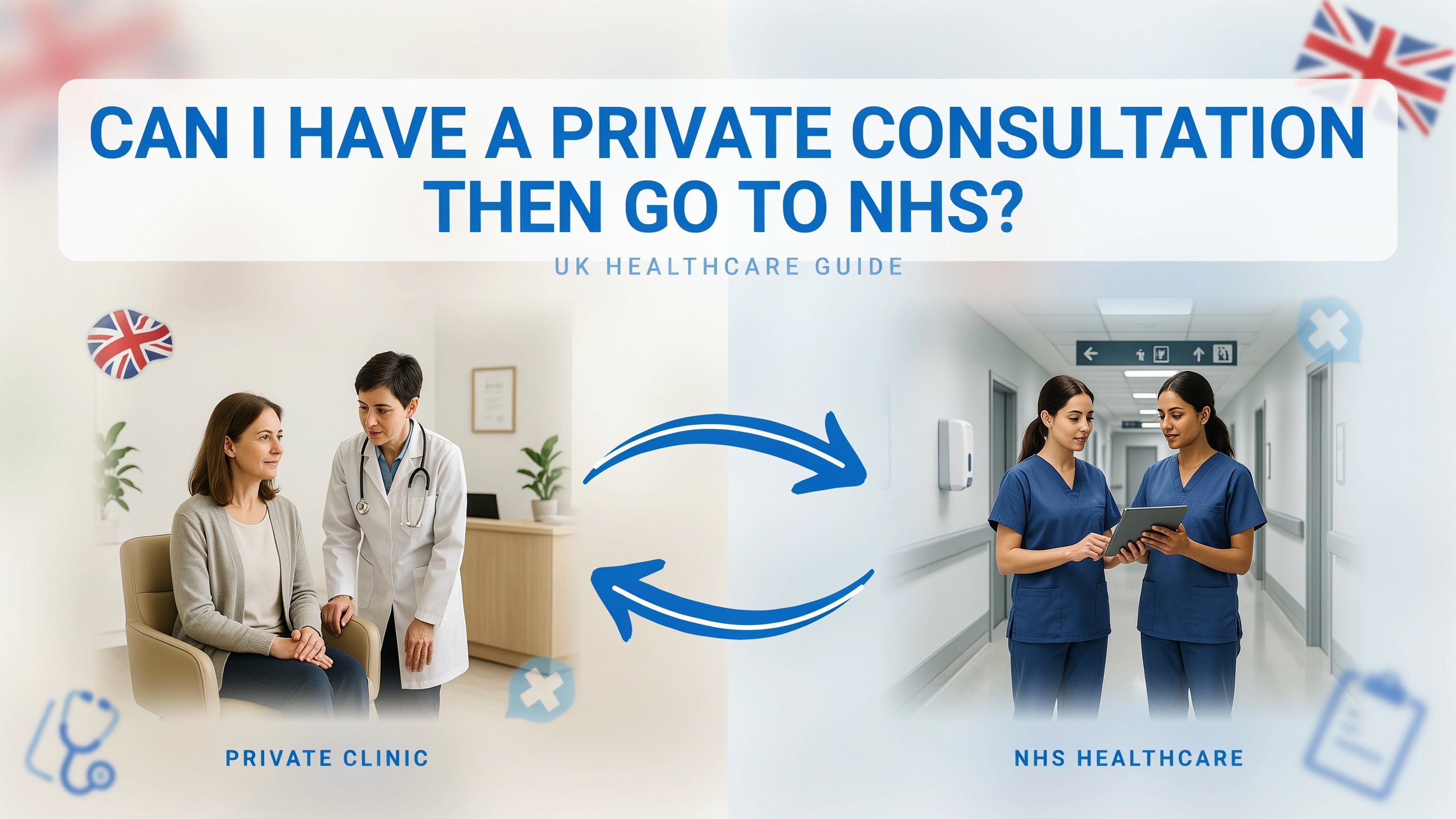
TL;DR: Yes, you can see a private GP or consultant and then have your treatment on the NHS. This is a common and accepted pathway. A private consultation can get you a diagnosis and treatment plan faster, but it does not move you up the NHS waiting list or guarantee faster NHS treatment once you transfer back. Your NHS referral and waiting time typically start from the point your NHS GP or hospital receives the relevant referral, not from your private appointment date.
This is one of the most practical questions people ask when NHS waits feel unbearable, and the honest answer involves an important distinction that gets lost in a lot of generic advice: a private consultation speeds up getting answers, not necessarily getting NHS-funded treatment itself.
Can You See a Private Consultant or GP Then Move to NHS Treatment?
Yes. This is a recognised and accepted pathway, and a great many people in the UK do exactly this.
NHS guidance on mixing NHS care and private treatment confirms that if you choose to pay for additional private care, your entitlement to NHS care remains unchanged, and the NHS will continue to provide, free of charge, all the care you would have been entitled to regardless of any private treatment you have also accessed.
The principle that makes this work is “clear separation.” You can use private care for one stage of your care — typically an initial assessment, diagnosis, or specialist opinion — and NHS care for another stage, such as the treatment itself, provided the two remain clearly distinct episodes rather than blended together within a single course of treatment. This separation exists so that the NHS never ends up subsidising or part-funding something that was started privately.
Does a Private Consultation Speed Up NHS Treatment?
Not directly, and this is the distinction that matters most. A private consultation gets you specialist advice and a diagnosis faster. It does not, by itself, get you NHS-funded treatment any sooner.
NHS guidance on waiting times in England confirms that if you are referred for a non-urgent physical or mental health condition, you have the legal right to start consultant-led treatment within a maximum of 18 weeks. Crucially, that waiting time starts from when the hospital or service receives your referral letter, or when you book your first appointment through the NHS e-Referral Service — not from the date of any private consultation you may have had beforehand.
This means a private GP or consultant visit does not give you a head start on the clock that actually governs NHS treatment timing. What it can do is shorten a different, often substantial, part of the overall journey: the wait simply to be seen and assessed in the first place, and the time spent waiting for an initial diagnosis. If you already know what is wrong and what treatment is needed by the time your NHS referral is made, you arrive at that 18-week clock with a clearer picture and, often, supporting information that can help your NHS care move along more efficiently from that point.
How the Handover From Private to NHS Actually Works
In practice, the route back into NHS care after a private consultation typically runs through your own NHS GP, not directly from the private consultant to a hospital.
A private consultant or GP who recommends NHS treatment will usually write a letter to you and to your NHS GP, summarising what was found and what they recommend. NHS guidance confirms this is the standard expectation, and that your GP practice should be allowed a reasonable amount of time, often around seven days, to receive and properly review this correspondence before you follow up with them.
Your NHS GP then uses this information to make the actual NHS referral, which is what starts your formal waiting time. You still typically need a GP referral for NHS-funded treatment, even when a private specialist has already made the diagnosis and recommendation — the private opinion informs the referral, but does not replace the referral process itself.
If, for whatever reason, your private consultant is unable to write directly to your NHS GP, you can request a copy of their letter or report yourself and take it to your NHS GP appointment, explaining clearly what was found and what you are hoping to arrange on the NHS.
What You Cannot Do When Mixing Private and NHS Care
A small number of firm rules govern how private and NHS care can be combined, and they are worth understanding clearly so you do not run into difficulty partway through.
You cannot split a single treatment episode between NHS and private funding. If you start a course of treatment privately — surgery, for example — you cannot then ask the NHS to fund or continue part of that same procedure. Equally, the NHS cannot subsidise or reduce the cost of treatment you have chosen to have privately.
A useful way to think about what is and is not permitted: paying privately for a diagnostic consultation and then having NHS-funded surgery for what was found is a recognised and accepted pathway. Having NHS surgery and then privately paying for an “add-on” to that same procedure, or splitting a single course of physiotherapy between NHS and private sessions for the same injury, is not.
Tests, scans, or procedures that a private consultant recommends are normally arranged and paid for privately as part of that private episode of care, rather than being passed to your NHS GP to organise on the NHS. If you want any further investigations to be NHS-funded going forward, this generally needs to happen through the NHS referral itself, rather than as a continuation of what was started privately.
What About Prescriptions and Tests Recommended Privately?
Prescriptions and tests recommended during a private consultation work slightly differently to the consultation itself, and it is worth knowing the mechanics before you commit to anything.
If a private consultant or GP recommends a new medication, this is usually prescribed privately, and NHS guidance confirms that if you take a private prescription to an NHS pharmacy, you will pay the full cost of the drug rather than the standard NHS prescription charge. For long-term medication, your NHS GP may be able to take over prescribing once you are stable, though this depends on whether the specific medicine falls within an agreed shared care arrangement between the private consultant and your NHS practice.
Tests and scans that a private consultant recommends, including blood tests, are normally arranged and paid for privately as part of your private care, rather than being requested through your NHS GP. Our private blood tests at The Private GP, for example, give you fast, same-day-or-next-day access to results without needing to wait for an NHS appointment slot just to have a sample taken.
Is This Worth Doing?
The honest answer depends entirely on what you are actually trying to solve.
A private consultation is most valuable when what you want is clarity, reassurance, and a clear plan sooner — particularly if uncertainty itself is the thing causing the most distress while you wait. Getting a proper diagnosis and a defined treatment recommendation, even weeks or months before your NHS appointment would otherwise have happened, gives you something concrete to act on and discuss with your NHS GP.
It is less useful if your primary goal is purely to get NHS-funded treatment itself delivered faster, since the part of the process this shortens is the diagnostic and advisory stage, not the treatment waiting time governed by the 18-week right.
A practical middle ground that works well for many people is using a private GP consultation specifically to get assessed promptly and to have a referral prepared and sent on your behalf, while the treatment itself remains entirely NHS-funded from that point onwards. This captures much of the benefit — speed of assessment, clarity, and a referral that is ready to go — without taking on the cost of private treatment itself.
Frequently Asked Questions
Will seeing a private GP affect my position on an NHS waiting list?
No. Choosing a private consultation does not move you up or down any existing NHS waiting list. Your position remains based on clinical need, entirely separate from any private care you have also accessed.
Do I still need a GP referral for NHS treatment after a private consultation?
Generally, yes. A private specialist’s findings and recommendations inform the referral, but your NHS GP usually still needs to make the formal referral for you to access NHS-funded treatment.
Can I have private tests and then NHS surgery for the same condition?
Yes, this is a recognised pathway, provided the two remain clearly separate episodes — private diagnostics followed by NHS-funded treatment. What is not permitted is splitting a single treatment episode, such as surgery, between NHS and private funding.
How long does it take for my NHS GP to receive a private consultant’s letter?
Allow a reasonable amount of time, often around seven days, for correspondence to reach and be reviewed by your NHS practice before following up. If you are concerned it has not arrived, you can request a copy from your private consultant to bring to your NHS appointment yourself.
What if my NHS GP won’t accept the private consultant’s recommendation?
Your NHS GP makes their own clinical judgement and is not obligated to act purely on a private consultant’s recommendation, particularly for prescribing decisions involving specialist medication. Discuss their concerns directly, as there may be a clinical or formulary reason for a different approach.