

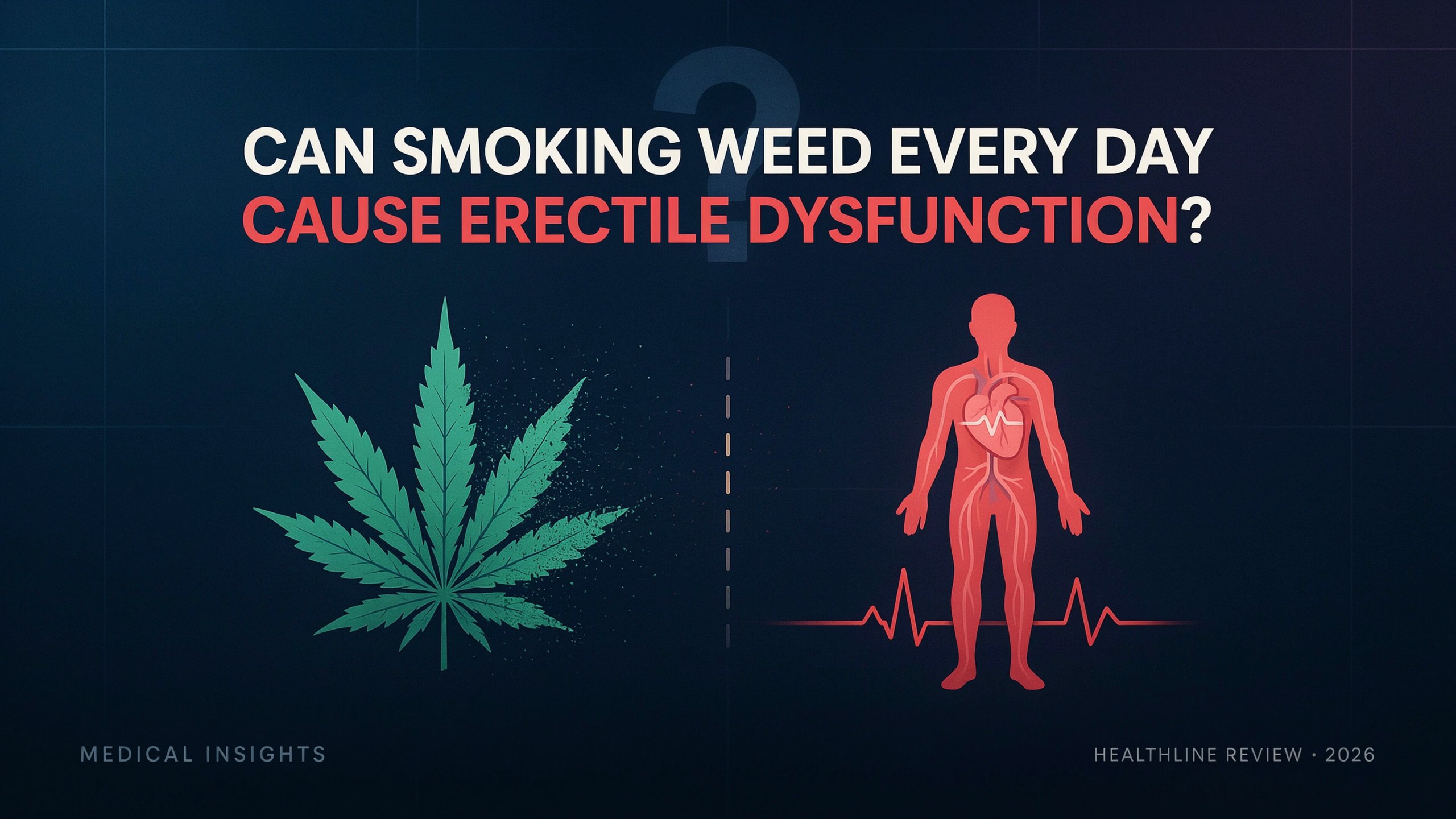
TL;DR: The evidence on cannabis and erectile dysfunction is genuinely mixed — it does not produce a simple yes or no. Daily heavy cannabis use has been associated with ED and testosterone deficiency in some studies, particularly in men with cannabis dependence. Other large studies show cannabis users have higher testosterone and better erectile function scores than non-users. Frequency, quantity, and dependence pattern appear to drive the risk more than cannabis use itself.
If you smoke cannabis every day and have noticed problems with erections, you are right to wonder whether the two are connected. The honest answer is: possibly — and the research is considerably more complicated than most articles on this topic suggest.
What follows is an accurate account of what the evidence actually shows, not a simplified verdict in either direction.
How Cannabis Interacts With the Systems Behind Erections
To understand how cannabis might affect erectile function, it helps to know that the endocannabinoid system — the network of receptors that THC acts on — plays a direct role in erection.
Research on the impact of cannabis on male sexual health, published in PMC, confirms that cannabinoid receptors are present in the corpus cavernosum — the spongy tissue inside the penis that fills with blood during an erection. The endocannabinoid system appears to influence erectile function through these receptors. At low concentrations, cannabinoid activation may facilitate some aspects of arousal. At higher concentrations — the kind associated with daily heavy use — cannabis appears to have peripheral antagonising effects on erectile function, inhibiting rather than supporting the vascular and smooth muscle mechanisms that produce an erection.
Cannabis also affects dopamine pathways involved in sexual motivation and arousal, and at high doses can acutely suppress both testosterone production and the hypothalamic-pituitary axis that regulates it. These effects are dose-dependent and context-dependent — which is exactly why the research produces such variable findings depending on the population studied.
Does Daily Cannabis Use Cause Erectile Dysfunction?
The honest answer is: it depends on how much you use and how often — and the research reflects that complexity directly.
On one side of the evidence, a large 2025 study published in the Journal of Sexual Medicine analysed data from 30,964 men with diagnosed cannabis abuse or dependence, matched against 1,473,182 controls. Men with cannabis dependence had a significantly increased risk of developing erectile dysfunction and testosterone deficiency at both one-year and five-year follow-up compared to matched men without cannabis diagnoses. The increased risk held across age groups, including men under 40.
On the other side, a large 10-year study of 7,809 men, reviewed in PMC’s analysis of cannabinoids and reproductive function, found that cannabis users actually exhibited higher serum testosterone, higher Sexual Health Inventory for Men (SHIM) scores, and greater sexual frequency than non-users.
These findings are not as contradictory as they first appear. The key difference is between cannabis dependence — daily heavy use meeting clinical diagnostic criteria — and general cannabis use, which includes occasional or moderate recreational users. The harmful associations cluster at the heavier, more dependent end of the spectrum. Occasional or moderate use in otherwise healthy men does not appear to carry the same ED risk that daily dependence does.
Frequency and quantity are what matter most, not cannabis use as a binary category.
Cannabis, Testosterone, and What Daily Use Does to Male Hormones
Testosterone is central to erectile function, libido, and sexual motivation. The evidence on what cannabis does to testosterone is, like the rest of the research in this area, mixed — but a pattern emerges when you look at frequency and severity of use.
The 10-year study of 7,809 men found higher testosterone in cannabis users overall. However, the same PMC review noted that in infertile men — a group with pre-existing reproductive health vulnerability — cannabis use was associated with lower testosterone. The population studied changes the outcome significantly.
The 2025 Journal of Sexual Medicine study was more specific. It found that men with cannabis abuse or dependence — not casual users, but those meeting criteria for problematic use — had significantly elevated rates of testosterone deficiency (defined as testosterone below 300 ng/dL) compared to matched controls. This risk was present at both short-term (one year) and longer-term (five year) follow-up.
The likely mechanism involves THC’s acute suppression of luteinising hormone (LH) — the pituitary signal that tells the testes to produce testosterone. Occasional suppression from intermittent use may not be clinically significant. Daily suppression from heavy chronic use, sustained over months and years, has the potential to lower baseline testosterone in a way that affects sexual function.
The Psychological Side — Cannabis, Anxiety, and Erections
Cannabis is one of the most commonly cited substances men use to try to enhance sexual experience — and for some men, in some contexts, it does exactly that. Reducing social anxiety, lowering inhibitions, and increasing tactile sensitivity are real effects that some users report, and they can facilitate sexual experience when performance anxiety is otherwise a barrier.
But for others — particularly daily users, those prone to anxiety, or those using high-THC products — cannabis does the opposite. Paranoia, increased heart rate, and heightened self-consciousness are well-recognised acute effects of cannabis, particularly at higher doses and in individuals with underlying anxiety. For a man who already has some erectile difficulty, using cannabis before sex and then experiencing heightened anxiety is a reliable recipe for performance failure.
Daily cannabis use is also associated with blunted dopamine reward responses over time — the same pathways involved in sexual motivation and arousal. Men who use cannabis heavily every day sometimes report reduced libido and reduced motivation for sex generally, not just difficulties with erection specifically. This is a different problem from a vascular ED, but it contributes to sexual dysfunction in a real and meaningful way.
What the Evidence Specifically Says About Smoking Every Day
The distinction between occasional and daily use is the most clinically important variable in this literature.
The 2025 Journal of Sexual Medicine study was specifically examining men with cannabis abuse or dependence — a diagnostic category that implies daily or near-daily heavy use with associated impairment. This is not the same as a man who smokes at weekends. The significantly elevated ED and testosterone deficiency risk found in that study applies to the dependent, heavy-use population, not to cannabis users as a whole.
PMC’s review of cannabinoid effects on reproductive function reinforces this dose-dependent framing. The evidence for harm concentrates at the higher-use, higher-dependency end of the spectrum. Cannabinoid receptor downregulation — where chronic overstimulation makes receptors less responsive — is a real consequence of heavy chronic use and affects the same receptor populations present in penile tissue.
If you smoke every day, the relevant question is not whether cannabis causes ED in general. It is whether your specific pattern of use — frequency, quantity, potency — places you in the category where the risk is meaningfully elevated. High-potency daily use over months and years is a different clinical picture from moderate use.
What to Do If You Smoke Daily and Have ED
The most useful first step is a period of honest observation. Reducing or stopping cannabis use for four to eight weeks and monitoring your erectile function gives direct personal evidence of whether cannabis is a significant contributing factor for you. This is not the same as a clinical recommendation to quit — it is a practical diagnostic step.
If your erectile function improves meaningfully after reducing cannabis use, you have your answer. If it does not, cannabis was probably not the primary driver, and further investigation is appropriate.
A full clinical assessment is warranted regardless. ED in a daily cannabis user should not be automatically attributed to the cannabis — particularly because ED is a recognised early marker of cardiovascular disease, diabetes, and testosterone deficiency, all of which need investigating in their own right.
A private GP consultation at The Private GP in Birmingham can assess the full picture, and our private blood tests cover testosterone, LH, FSH, blood pressure, blood glucose, and a full cardiovascular risk panel — the markers that reveal what is actually driving the ED beyond any single lifestyle factor.
Tell your GP you use cannabis. The information is clinically relevant and a good GP will use it to help, not judge.
Frequently Asked Questions
Does weed lower testosterone permanently?
Not permanently in most cases. Testosterone suppression from cannabis appears to be related to ongoing use and may be reversible after stopping. However, in men with cannabis dependence, testosterone deficiency has been found at both one-year and five-year follow-up — suggesting prolonged impact in heavy users. A blood test is the only way to know your current levels.
Can stopping cannabis reverse erectile dysfunction?
For some men, yes — particularly where daily use has been suppressing testosterone or contributing to performance anxiety. A four-to-eight week period without cannabis gives a clearer picture of its individual contribution. Where ED persists after stopping, further clinical investigation is needed to identify other causes.
Is cannabis worse than tobacco for erectile dysfunction?
The evidence suggests tobacco carries a clearer and more direct vascular risk for ED — nicotine-induced vasoconstriction and arterial damage are well-established mechanisms. Cannabis has a more complex and dose-dependent relationship with ED. For daily heavy users, the risks are real but operate through different pathways. Combining both daily tobacco and daily cannabis compounds the risk.
Can cannabis help with ED by reducing anxiety?
For some men in some contexts, yes — particularly where performance anxiety is the primary driver of ED and cannabis reduces that anxiety. But this is not a reliable or safe treatment for ED, and daily use can produce the opposite effect over time by blunting dopamine reward responses and increasing anxiety at higher doses.
Should I tell my GP I smoke cannabis if I have ED?
Yes, always. Cannabis use is clinically relevant information when investigating ED — it affects testosterone, influences vascular function, and has psychological effects on sexual performance. A GP cannot give you the most accurate assessment without this information. The consultation is confidential and the information will be used to help you, not reported elsewhere.