


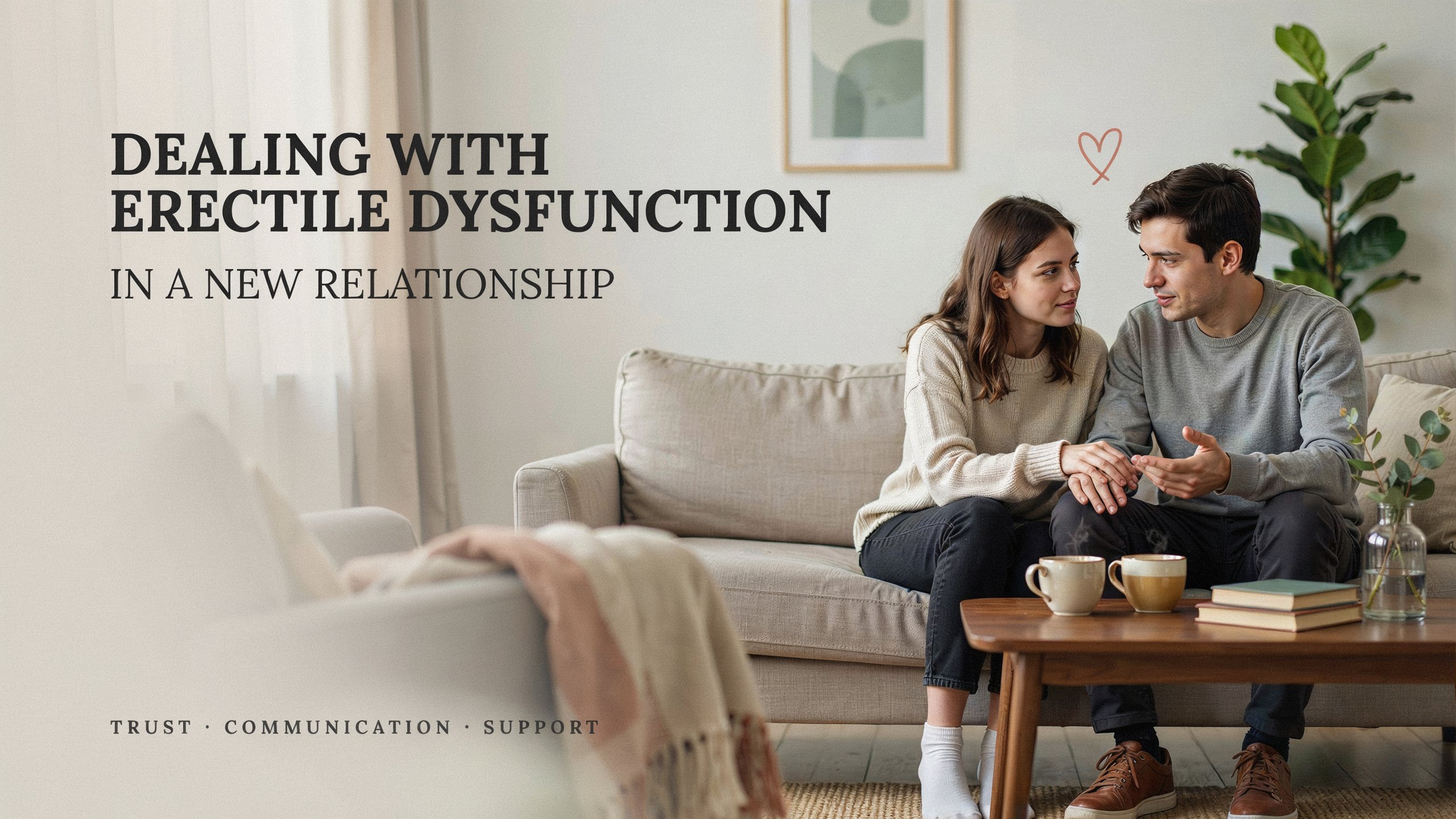
TL;DR: ED in a new relationship is extremely common and usually driven by performance anxiety rather than a physical problem. Research shows that up to 30% of new ED diagnoses are in men under 40, and in younger men without cardiovascular risk factors, psychological causes dominate. The anxiety-erection cycle is self-reinforcing — but it is also breakable. Understanding what is happening, communicating honestly with your partner, and knowing when to seek help are the three things that change the outcome.
Struggling to get or keep an erection with a new partner is one of the most common and least talked about sexual health experiences men have. It does not mean something is wrong with you. It does not mean you are not attracted to her. And it almost certainly does not mean you have a serious medical problem.
What it usually means is that your mind is under a kind of pressure that your body cannot perform through — and that is a fixable problem, not a permanent one.
Why ED in a New Relationship Is So Common
New relationships carry a unique set of psychological pressures that simply do not exist in established ones. The desire to impress, the uncertainty about whether the other person is equally attracted to you, the unfamiliarity of a new body and new dynamic, the fear of being judged — these are not trivial concerns. They activate the nervous system’s threat response in a way that directly competes with the physiological signals needed to produce an erection.
Research published in PMC on erectile dysfunction in fit and healthy young men confirms that in younger men without vascular risk factors, psychogenic causes — including sexual performance anxiety, relationship and social factors, anxiety, and depression — are the dominant aetiology of ED. The paper also notes that ED in young men is frequently underestimated and attributed to transient psychological causes without proper investigation, which is a clinical problem in its own right.
A narrative review of ED in young adults published in PMC found prevalence rates as high as 35% in younger men, with psychogenic causes — particularly performance anxiety and relationship factors — consistently among the most common drivers. This is not a rare experience. It is the norm for a significant minority of men navigating new relationships, and the shame around it makes it worse than it needs to be.
The Performance Anxiety Cycle That Keeps It Going
One episode of ED with a new partner creates something more damaging than the episode itself — it creates anticipation of the next one.
The man who could not maintain an erection last time spends the next encounter monitoring himself. Am I getting hard enough? Is it staying? What does she think? This self-monitoring — sometimes called spectatoring — pulls attention away from the erotic experience and into a running internal commentary on physical performance. And erections, which depend on the nervous system being in a state of arousal rather than vigilance, do not survive that kind of scrutiny.
The result is that the anxiety prevents the very thing it is anxious about failing to happen. The cycle becomes self-sustaining. Not because anything is physically wrong, but because the mind has learned to associate sex with this partner — or sex generally — with the possibility of failure. Once that association is established, the anticipatory anxiety arrives before sex begins, sometimes long before.
This is the mechanism behind performance anxiety ED, and it is entirely distinct from the vascular or hormonal mechanisms behind physical ED. Understanding that the cycle is psychological does not make it less real. But it does point directly at what breaks it — and it is not the same as what treats physical ED.
Practical Steps That Actually Break the Anxiety Cycle
The most effective thing most men do not try is simply taking the pressure off penetrative sex for a period of time.
This sounds counterintuitive. But the anxiety cycle feeds on a specific expectation — that sex means erection, penetration, and performance in a particular sequence. Removing that expectation, even temporarily, removes the source of the anxiety. Allowing physical intimacy without the destination of intercourse — kissing, touching, mutual pleasure without the goal of penetration — lets the nervous system relax. Erections often return naturally in that lower-pressure context, and with them, confidence.
Alcohol is the other variable worth addressing directly. Most men who experience performance anxiety use alcohol to manage it, because it reduces social anxiety in the short term. The problem is that alcohol is a vasodilator at low doses and a suppressant of erectile function at moderate to high doses — the amounts typically consumed before sex. A man who needs three drinks before sex to manage anxiety is also three drinks into impairing his erectile function. The two effects cancel each other out, and often the impairment wins.
Staying present matters more than it sounds. The spectatoring cycle is broken by attention — not forcing attention onto the physical experience, but by being curious and engaged with the other person rather than monitoring yourself. This is what mindfulness-based approaches to performance anxiety target, and the evidence for their effectiveness is solid.
Communication is its own topic — and important enough to cover separately.
When and How to Tell a New Partner About ED
Most men say nothing. They withdraw from the situation, make excuses, reduce how often they initiate, and manage the problem in silence. The partner, without context, experiences something that looks like reduced interest or emotional distance — and draws conclusions that are usually worse than the truth.
The conversation does not need to be heavy or prolonged. It does not need to happen in the bedroom, during sex, or immediately after a difficult moment. A calm private time — not charged with the aftermath of an intimate experience — is the right context.
Something simple and honest works better than elaborate explanation. “I’ve been experiencing something with erections that I want you to know about — it’s nothing to do with how attracted I am to you, it’s anxiety-related and I’m dealing with it” gives a partner the information she needs to respond helpfully rather than misinterpret what is happening.
The research on partner response is consistently more reassuring than men expect. Partners almost universally respond better to honesty than to withdrawal. The conversation that feels humiliating in anticipation is, in practice, usually a moment that brings two people closer rather than apart. What partners find most difficult is the silence and the distance — not the ED.
When ED in a New Relationship Is Actually a Physical Problem
Most ED in younger men in new relationships is psychogenic. But not all of it — and knowing the difference matters.
The most useful clinical pointer is morning erections. A man with psychogenic ED typically has intact or near-normal morning and nocturnal erections — his erectile mechanism is functioning normally, but performance anxiety is blocking it during partnered sex. If morning erections are present and strong, the problem is almost certainly psychological. If morning erections are absent or significantly reduced, that is a signal that the underlying erectile mechanism may be impaired, and physical causes need to be investigated.
The same applies if ED occurs consistently across all contexts — not just with a new partner, but during masturbation, not only in new situations, but always. Situational ED that occurs only with partners but not alone strongly suggests a psychological component. Universal ED across all contexts suggests something physical.
PMC’s narrative review on ED in young adults is clear that a significant proportion of younger men presenting with ED do have organic causes — endothelial dysfunction, hormonal imbalances, metabolic syndrome, and neurogenic factors. The NHS confirms that ED can be an early marker of cardiovascular disease even in younger men. Dismissing all ED in young men as anxiety without a proper assessment is a clinical error. A proper assessment checks testosterone, blood pressure, blood glucose, and cholesterol — the markers that reveal whether something physical needs treating alongside any psychological work.
Should You Use ED Medication With a New Partner?
For performance anxiety ED specifically, PDE5 inhibitors — sildenafil (Viagra) or tadalafil (Cialis) — can function as a circuit-breaker rather than a long-term treatment.
The mechanism is straightforward. A man who has had several anxiety-driven failures with a new partner has built an anticipatory anxiety response that now precedes sex. Taking sildenafil before sex provides a reliable physical safety net — the erection is more likely to occur regardless of the anxiety present. After several positive experiences with the medication, the anxiety begins to reduce because the fear of failure diminishes. Some men are then able to stop the medication and find that their erectile function is restored without it.
This is a legitimate and evidence-supported use of PDE5 inhibitors — not as a treatment for a physical condition, but as a psychological reset mechanism.
The honest caveat: this approach works best when the underlying anxiety is addressed at the same time, not when the medication becomes a permanent crutch that prevents the confidence from rebuilding. Using it as a temporary bridge while also working on the anxiety — through communication, removing performance pressure, or if needed, short-term sex therapy — produces the best long-term outcomes.
Frequently Asked Questions
Is it normal to have ED with a new partner but not when masturbating?
Yes — and it is one of the clearest signs that the cause is psychological rather than physical. The ability to achieve erection during masturbation confirms the physical mechanism is intact. Situational ED that occurs only in partnered contexts is the hallmark of performance anxiety.
How long does performance anxiety ED last?
Without intervention, it can persist for months — because the anxiety cycle is self-sustaining. With the right approach — reducing performance pressure, communicating with a partner, or using medication as a temporary circuit-breaker — most men see meaningful improvement within a few weeks to a couple of months.
Will ED medication help if my ED is caused by anxiety?
Yes, often. PDE5 inhibitors work regardless of the cause of ED — they improve the physiological conditions for erection even when the barrier is psychological. For performance anxiety specifically, they can break the failure cycle and allow confidence to rebuild. They are a tool, not a dependency.
Should I tell a new girlfriend I have ED?
Yes — and sooner rather than later in most cases. The conversation is almost always less difficult than anticipated, and partners respond far better to honesty than to the withdrawal and distance that silence creates. Framing it simply and calmly, away from the bedroom, works best.
When should I see a doctor about ED in a new relationship?
If morning erections are absent or significantly reduced, if ED occurs consistently during masturbation as well as partnered sex, or if it has not improved after four to six weeks of trying to address it, a clinical assessment is appropriate. ED at any age can occasionally reflect an underlying physical condition worth identifying and treating.