


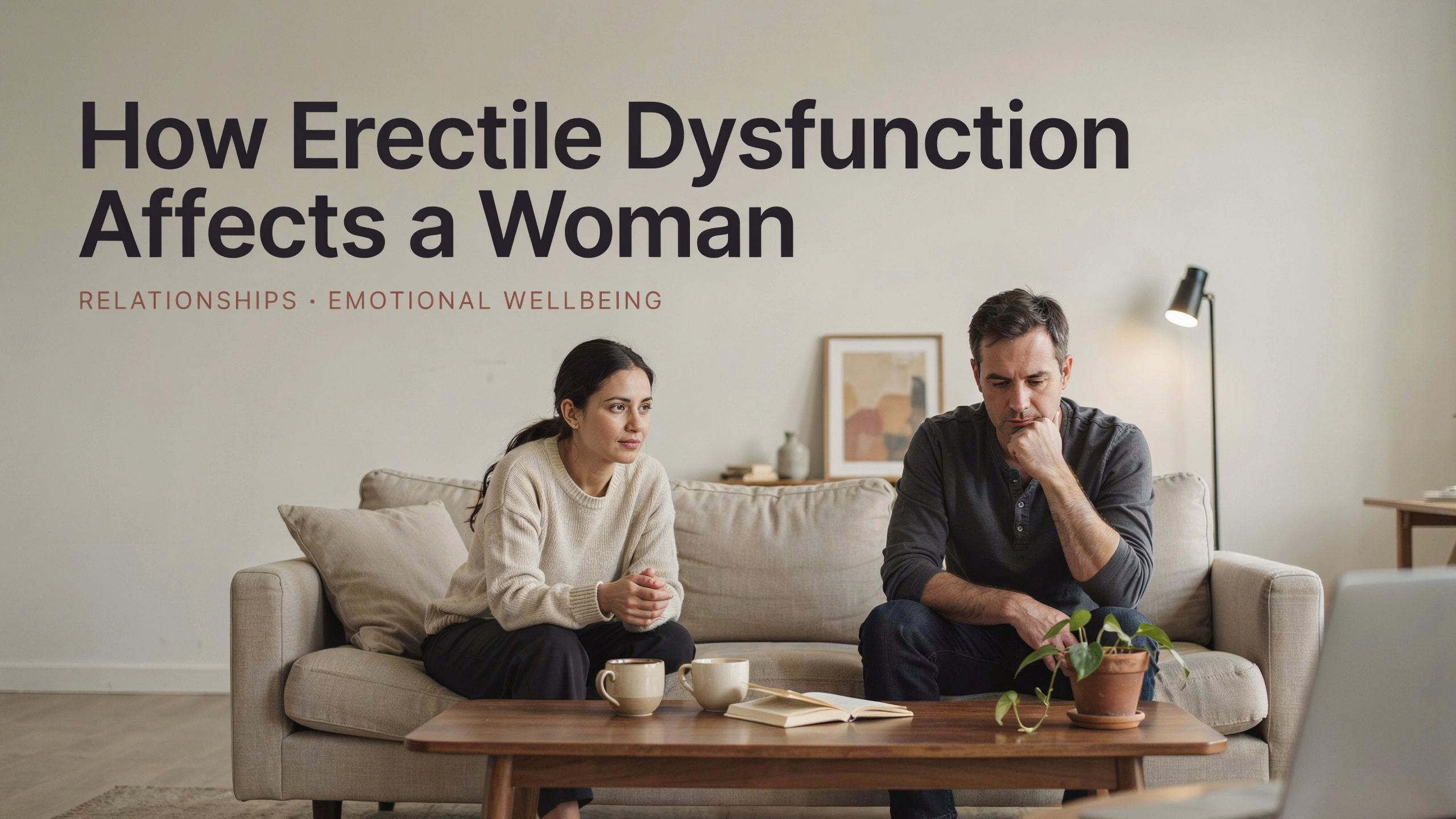
TL;DR: Erectile dysfunction affects female partners in significant and well-documented ways — emotionally, sexually, and relationally. Research shows that women whose partners have ED commonly experience feelings of rejection, self-doubt, reduced libido, and decreased relationship satisfaction. These responses are entirely understandable and are not a reflection of the relationship’s strength or the woman’s desirability. ED is a medical condition. When it is treated, female partners consistently report improvements in their own sexual experience and relationship satisfaction.
When a man has erectile dysfunction, the conversation almost always centres on him. His confidence, his diagnosis, his treatment options. But the woman in the relationship is navigating her own emotional experience — one that research shows is significant, common, and rarely talked about openly.
This is not a secondary story. It is an equally important one.
The Emotional Toll a Partner’s ED Takes on Women
The most consistent finding in research on ED and relationships is that women whose partners have erectile dysfunction commonly feel rejected — and blame themselves for it.
A comprehensive review of the psychology of erectile dysfunction published in Sage Journals identified a systematic review of eight studies showing that partners of men with ED report a significantly lower quality of life. The emotional effects documented include feelings of being unattractive, feeling rejected, feeling unloved, decreases in self-esteem, and frustration. Women also report confusion, worry that the man is losing interest, and in some cases anxiety that he is having an affair.
None of these responses are irrational. They are the predictable result of intimacy disappearing without explanation.
When a man begins struggling with ED, his most common response is to withdraw. He avoids situations where sex might be expected, becomes less physically affectionate, and stops initiating. To a woman who does not know what is happening — because the conversation has not happened — this reads as exactly what it looks like: distance, loss of interest, emotional disconnection. The ED itself is not the problem she experiences. The silence around it is.
How a Partner’s ED Reduces Female Sexual Desire and Satisfaction
ED does not just affect a woman’s emotional wellbeing. Research consistently shows it affects her own sexual function too — her desire, her arousal, and her ability to reach orgasm.
Research published in PMC found that women whose partners had ED reported significantly lower sexual activity, diminished sexual relationship satisfaction, and significantly more relationship problems than women whose partners did not have ED. The same research confirmed that after their partner developed ED, women reported a decrease in sexual desire, sexual arousal, and orgasm during intercourse.
This is not a coincidence or a secondary effect. Female sexual response is deeply contextual. Arousal in women is strongly tied to psychological safety, emotional connection, and feeling wanted. When a partner withdraws, when intimacy becomes fraught, when sex itself becomes associated with failure and disappointment, the conditions for female sexual response deteriorate. A woman does not need to have any physiological problem for her sexual function to reduce — the relational environment alone is enough.
Understanding this matters because it means ED is, in a very real clinical sense, a couples condition — not a solo one. Both people are affected. Both people benefit when it is treated.
Why So Many Women Blame Themselves — and Why That Is Wrong
The self-blame response is one of the most painful and most documented aspects of living with a partner who has ED.
The Sage Journals review found that women commonly interpret their partner’s erectile difficulty as a sign that he is no longer attracted to them — that something about her has changed, that she is not desirable enough, that the relationship has run its course emotionally. Some research suggests that up to 39% of female partners report feeling undesirable or less feminine as a direct result of their partner’s ED — even when the cause is entirely physical and entirely unrelated to attraction.
This self-attribution is not a character flaw. It is a natural response to a situation where the obvious explanation — that he no longer finds her attractive — seems to fit the evidence as she sees it. What she does not see is the internal experience of the man: the shame, the performance anxiety, the desperate attempt to avoid the situation entirely because confronting it feels worse than avoiding it.
A survey of 2,000 British women found that one in three reported their partner had experienced ED at least once during intercourse. Of those, 82% agreed it should not be a taboo subject. Yet fewer than half said they would feel comfortable discussing it with their partner. The gap between knowing it should be talked about and actually being able to talk about it is where the damage accumulates.
ED has identifiable medical causes — cardiovascular disease, diabetes, high blood pressure, low testosterone, medication side effects, psychological factors. The NHS confirms that it is one of the most common sexual health conditions in men and is treatable in the majority of cases. It has nothing to do with how attractive a man finds his partner.
How Intimacy Withdrawal Damages a Relationship More Than the ED Itself
If there is one pattern that emerges most consistently from research on couples and ED, it is this: the erectile dysfunction itself is rarely what breaks a relationship. The silence and withdrawal around it is.
A man who cannot maintain an erection and says nothing leaves his partner to construct her own narrative. She will. And that narrative will almost always be more damaging than the truth.
A man who says — in a calm, non-pressured moment, not during or immediately after a sexual difficulty — “I’ve been having a problem I need to tell you about and get sorted” changes the relational dynamic entirely. His partner’s self-blame stops. Her confusion stops. The avoidance cycle breaks. The relationship becomes a team problem rather than a personal failure.
Timing matters. The conversation should not happen in the bedroom, during sex, or in the immediate aftermath of a difficult moment. A calm, private time when neither person is stressed or tired gives the best chance of the conversation going well. Framing it clearly — this is a medical problem I want to address, not a reflection of how I feel about you — removes the ambiguity that causes most of the damage.
What Changes for Women When ED Is Treated
The evidence here is among the most important in this area — because it shows clearly that treatment is not just for the man.
Research published in PMC found that women whose partners initiated PDE5 inhibitor therapy — sildenafil or tadalafil — experienced significantly more sexual desire, arousal, and orgasm compared to women whose partners did not use treatment. Relationship satisfaction improved. The sexual and emotional difficulties that had built up around the ED were not fixed by communication alone — they were fixed by treating the underlying condition.
The same research found something equally significant: female attitudes towards their partner’s ED and its treatment were strongly associated with whether the man mentioned ED to a doctor and whether he tried medication. Women who were supportive, who encouraged treatment, and who framed it as something to address together were more likely to have partners who sought help.
This is a powerful finding. A woman’s response to her partner’s ED — whether she takes it personally and withdraws, or whether she normalises it and encourages him to get it assessed — directly influences whether the man gets the help that would benefit them both.
What to Do If Your Partner Has Erectile Dysfunction
The most useful thing a woman can do is disentangle the ED from her own sense of worth — which is easier said than done, but genuinely possible once the medical reality is understood. ED is not a verdict on the relationship. It is a circulatory problem, a hormonal problem, a medication side effect, or a psychological response to stress and anxiety. It is treatable.
If the conversation has not happened yet, choose a calm moment. Not in the bedroom. Not when either person is tired, stressed, or upset. Something simple and honest — “I’ve noticed things have been difficult lately and I’d really like us to talk about it” — opens the door without pressure.
If the conversation has happened but your partner has not sought medical help, the evidence is clear that encouraging him to see a GP — framing it as something you want addressed for both of you — is more likely to result in action than leaving it to him to decide alone.
If there are deeper relational difficulties that go beyond the ED itself, couples therapy or sex therapy can be genuinely helpful alongside medical treatment. A GP can advise and refer.
At The Private GP in Birmingham, our private GP consultation can assess the likely causes of ED and discuss treatment options at a same-day appointment — no referral needed, no waiting list. Our private blood tests cover testosterone, cardiovascular markers, and metabolic health — the markers that reveal what is actually driving the ED and what can be done about it.
Frequently Asked Questions
Is it normal to feel rejected when your partner has erectile dysfunction?
Yes — and research confirms it is extremely common. Women routinely misinterpret their partner’s intimacy withdrawal as personal rejection. It is a natural response to a confusing situation, not a sign of insecurity. Understanding that ED has physical or psychological causes unrelated to attraction usually helps significantly.
Can a partner’s ED cause sexual problems in women?
Yes. Research consistently shows that women whose partners have ED experience reductions in their own sexual desire, arousal, and ability to orgasm. Female sexual response is closely tied to relational context — when the emotional and physical environment around intimacy deteriorates, female sexual function follows.
How do I talk to my partner about his erectile dysfunction?
Choose a calm, private moment away from the bedroom and not during or after a difficult intimate experience. Keep it simple, warm, and solution-focused — frame it as something you want to address together, not a criticism. Men are more likely to seek help when their partner encourages it without pressure.
Will treating his ED improve our relationship?
The evidence says yes. Women whose partners begin treatment with PDE5 inhibitors report significant improvements in their own sexual desire, arousal, and orgasm, as well as improved relationship satisfaction. Treating ED benefits both people — not just the man with the diagnosis.
Should both partners be involved in ED treatment?
Ideally, yes. ED is a couples condition in its impact, even if one person has the diagnosis. Research shows that female attitudes towards ED treatment directly influence whether men seek help. Attending a GP appointment together, or at least discussing the findings together, produces better outcomes than managing it in isolation.