


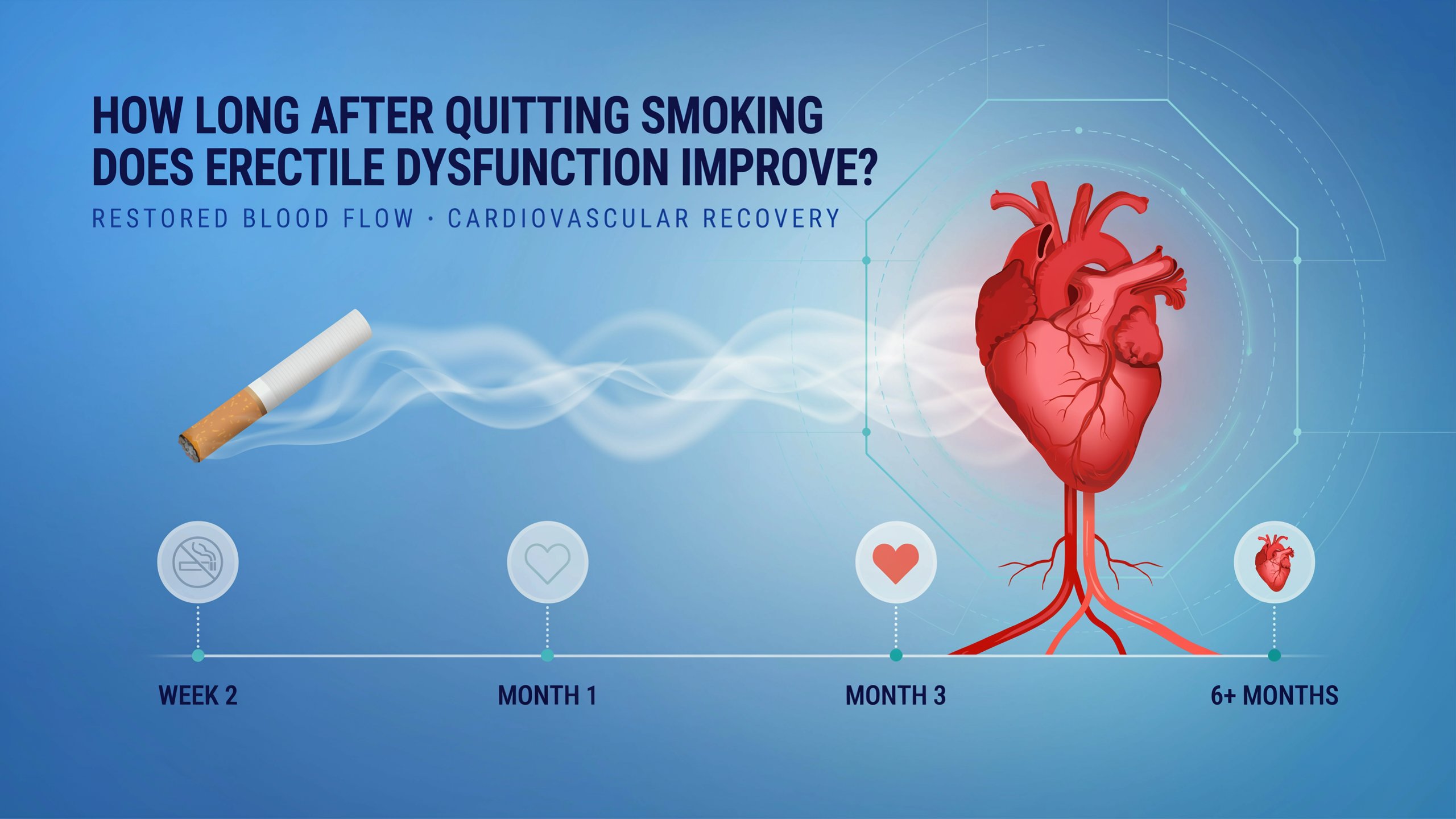
TL;DR: Measurable improvements in penile blood flow can occur within 24 to 36 hours of quitting smoking. Noticeable improvements in erectile function typically begin within 2 to 12 weeks. Around 50% of men report significant improvement within six months, with continued gains over the following year. Recovery depends on age, how long and heavily you smoked, and whether other cardiovascular risk factors are present. Younger men and lighter smokers tend to recover faster.
If you smoke and have erectile dysfunction, quitting is the single most effective lifestyle change you can make for your sexual health. The recovery starts faster than most men expect — and having a realistic timeline makes it easier to stay motivated when progress feels slow.
How Smoking Damages Erectile Function in the First Place
An erection is a vascular event. Blood needs to flow into the penile arteries in volume, those arteries need to dilate properly, and the tissue needs to be able to hold that blood pressure long enough for sex. Smoking damages every part of that mechanism.
Research published in PMC on the effects of cigarette smoking on erectile dysfunction confirms that cigarette smoke causes vasoconstriction — narrowing of blood vessels — reduces the production of nitric oxide (the molecule that triggers arterial dilation and allows erection to occur), and damages the endothelium, the inner lining of blood vessels that regulates how they respond to signals. Over time, smoking accelerates atherosclerosis — the build-up of arterial plaque — which physically narrows the vessels supplying the penis.
The damage is cumulative. A man who smokes 20 cigarettes a day for ten years has significantly more vascular damage than someone who smoked lightly for two years. But for most men, especially those under 50, the damage is largely reversible — and the body begins repairing it almost immediately after the last cigarette.
How Quickly Does Erectile Function Improve After Quitting Smoking?
Faster than most men expect — even in the first 24 hours.
A clinical study using penile colour Doppler ultrasonography — which directly measures blood flow in the penile arteries — assessed 20 men with ED who smoked 20 to 40 cigarettes daily. When the same men were retested 24 to 36 hours after stopping smoking, measurable improvements in peak systolic velocity and end-diastolic velocity were already detectable. The vascular effects of nicotine — which cause acute constriction of penile blood vessels — begin reversing almost immediately after quitting.
Those early changes in blood flow do not translate instantly into reliable erections. That takes longer. For most men, noticeable improvements in erectile function begin somewhere between two and twelve weeks after quitting. The two to twelve week window reflects the time it takes for endothelial function to start recovering, blood pressure to reduce, and circulation to improve meaningfully throughout the body.
By six months, around 50% of men report significant improvement in erectile function compared to when they were smoking. Gains continue beyond that — some men report their best recovery at the twelve-month mark, when vascular repair has had more time to progress. After a year without smoking, a former heavy smoker’s cardiovascular system has changed substantially from where it was.
What the Research Specifically Shows About Smoking Cessation and ED
The clinical evidence for quitting improving erectile function is consistent and compelling.
A study published in PMC by Harte and Meston — the first empirical investigation of smoking cessation and sexual health in men — enrolled male smokers in an eight-week cessation programme using nicotine patches and counselling. Men who successfully quit, compared to those who relapsed, showed enhanced erectile tumescence responses and faster onset to maximum subjective sexual arousal at follow-up. The study concluded that smoking cessation significantly enhances both physiological and self-reported indices of sexual health in long-term male smokers, regardless of baseline erectile impairment.
A large observational study — the REDUCE trial, published in BJU International — analysed sexual function data from 6,754 men divided into lifelong non-smokers, former smokers, and current smokers. Former smokers had significantly better erectile function and sexual activity than current smokers, even after controlling for age and other variables. The data supports the idea that quitting, even after years of smoking, moves men meaningfully towards the sexual function profile of non-smokers.
An earlier study by Guay et al., frequently cited in the literature, found that cessation of smoking rapidly and measurably decreases erectile dysfunction — reinforcing the early recovery data from the Doppler research.
Not every man fully recovers. Men with severe and long-standing ED, significant arterial damage, or multiple additional cardiovascular risk factors may see improvement without full resolution. Quitting is still worth it — it removes the ongoing insult to vascular health and prevents further deterioration, even where full recovery is limited.
What Affects How Quickly ED Improves After Quitting
Recovery is not the same for every man. Several factors shape how quickly — and how fully — erectile function returns.
Age
This is the most significant variable. Men under 50 tend to recover faster and more completely than older men. Some studies suggest that measurable erectile improvement from smoking cessation is concentrated almost entirely in men who quit before 50 — after which the accumulated arterial stiffening and atherosclerosis become harder to reverse. That is not a reason to delay quitting at any age, but it is a reason to act sooner rather than later.
Duration and Intensity of Smoking
A man who smoked five cigarettes a day for three years has accumulated far less vascular damage than someone who smoked 30 a day for 20 years. Lighter smokers tend to see quicker and more complete improvement. Heavier, longer-term smokers may take longer and may reach a lower ceiling of recovery.
Cardiovascular Risk Factors
Smoking rarely acts alone. Many men who smoke also have hypertension, elevated cholesterol, or early diabetes — all of which independently damage penile blood flow. Quitting removes one driver of the problem, but if other risk factors remain untreated, recovery will be slower and less complete. Managing blood pressure, cholesterol, and blood glucose alongside smoking cessation produces significantly better outcomes than quitting alone.
Psychological Factors
Performance anxiety — often developed after repeated episodes of ED — can persist even when vascular health improves. A man whose erections are recovering physically may still struggle if the anxiety around sex has become entrenched. In these cases, the improvement from quitting may be there but masked by psychological inhibition, and brief psychological support or sex therapy can help unlock the physical progress that has already occurred.
When Quitting Alone May Not Be Enough
For many men, quitting smoking will produce meaningful and satisfying improvement in erectile function within weeks to months. For others — particularly those who smoked heavily for many years, are over 50, or have additional health conditions — quitting is an essential step but not always a sufficient one on its own.
If ED has not improved meaningfully after three to six months of not smoking, a clinical assessment is warranted. The ED may have additional drivers — low testosterone, uncontrolled hypertension, diabetes, or significant arterial disease — that quitting cannot reverse on its own.
PDE5 inhibitors such as sildenafil or tadalafil can be used in the period after quitting to support erectile function while vascular recovery progresses. They do not interfere with the recovery process — they work alongside it. For men who find that quitting has not produced the improvement they expected, adding a PDE5 inhibitor while continuing to abstain from smoking often makes a significant difference.
A private GP consultation at The Private GP in Birmingham can assess the full picture — blood pressure, testosterone, lipid panel, and blood glucose — and identify any additional factors driving the ED that need their own treatment. Our private blood tests cover all the relevant cardiac and hormonal markers with same-day results.
How to Quit Smoking — What Actually Works
The most effective quit attempts combine behavioural support with pharmacological treatment. Going cold turkey without support has a much lower success rate than a structured programme.
The NHS confirms that NHS Stop Smoking Services significantly improve quit rates and are available free of charge. They combine counselling with pharmacotherapy — the most effective options being combination nicotine replacement therapy (a patch plus a shorter-acting product such as gum or lozenge used together), varenicline (Champix), and bupropion.
Varenicline is the most effective single pharmacological aid for smoking cessation and is available on NHS. It works by reducing cravings and the rewarding effect of cigarettes.
Nicotine replacement therapy does still deliver nicotine to the body, which means some of the acute vasoconstriction continues during its use. This is a reasonable trade-off — the goal is to break the habit and eliminate the thousands of other chemicals in cigarette smoke, with nicotine dependency addressed more gradually. Erectile function improvements during NRT use will be more modest than after full nicotine cessation, but the longer-term gains from successfully quitting via NRT are well worth it.
Frequently Asked Questions
Can quitting smoking completely cure erectile dysfunction?
For some men, yes — particularly younger men whose ED was primarily caused by smoking. For others, quitting significantly improves but does not fully resolve ED, especially where long-term arterial damage or additional risk factors are present. A GP assessment helps identify what else may need treating.
Do younger men recover erectile function faster after quitting smoking?
Yes, consistently. Research shows that erectile improvements from smoking cessation are most pronounced in men under 50. Younger men have had less cumulative arterial damage and greater capacity for vascular recovery. Quitting at any age helps — but earlier is meaningfully better.
Does using nicotine replacement therapy still improve ED?
Partly. NRT continues to deliver nicotine, which maintains some vasoconstriction. The acute effects of nicotine on penile blood flow persist during NRT use. However, eliminating the thousands of other harmful chemicals in cigarette smoke still provides significant vascular benefit — and the goal of NRT is to facilitate full cessation, after which the full recovery trajectory begins.
How long does it take for blood vessels to recover after quitting smoking?
Early improvements in blood vessel function begin within days. Meaningful endothelial recovery develops over weeks to months. Significant reductions in atherosclerotic plaque and arterial stiffness take longer — months to years — and depend on age, duration of smoking, and other cardiovascular risk factors.
Should I take ED medication while waiting for improvement after quitting smoking?
This is worth discussing with your GP. PDE5 inhibitors such as sildenafil and tadalafil are safe and do not interfere with vascular recovery — they work alongside it. For men who find the wait difficult or whose erectile function is not recovering as expected after a few months, medication alongside continued abstinence from smoking is a practical and effective approach.