

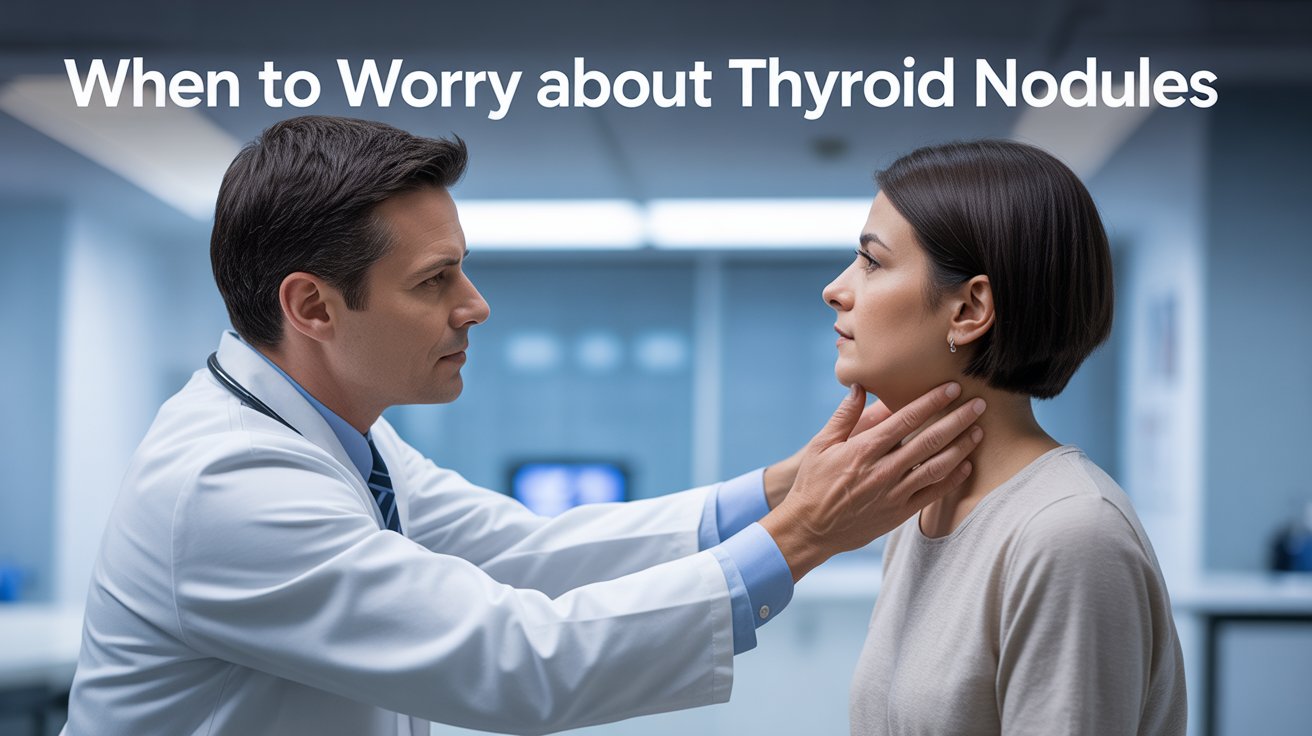
Discovering a lump in your neck — or being told during a routine scan that you have a thyroid nodule — is understandably unsettling. But the reassuring reality is that the vast majority of thyroid nodules are entirely benign. Around 95% are non-cancerous, and many people live with thyroid nodules for years without any symptoms or complications. That said, knowing when to worry about thyroid nodules — and what warning signs deserve prompt medical attention — is important. The 5% that do require further investigation are best identified early, and certain symptoms should never simply be watched and waited upon.
This guide explains what thyroid nodules are, the characteristics that raise clinical concern, the red flag symptoms that require urgent assessment, and what the investigation process looks like in the UK.
What Is a Thyroid Nodule?
Simply put, a thyroid nodule is an abnormal growth or lump that develops within the thyroid gland — the butterfly-shaped gland at the front of the neck that produces hormones regulating metabolism, heart rate, and energy. Nodules can be solid, fluid-filled (cystic), or a mixture of both. They vary considerably in size, from a few millimetres to several centimetres, and can occur singly or in clusters (a multinodular goitre).
Most thyroid nodules develop without any obvious cause. Known contributing factors include autoimmune conditions such as Hashimoto’s thyroiditis, previous radiation exposure — particularly during childhood — iodine deficiency, and a family history of thyroid disease. Women are significantly more likely to develop thyroid nodules than men, and the risk increases with age. Many nodules are discovered incidentally during imaging carried out for an entirely unrelated reason — a cervical spine scan or chest CT, for example — rather than because they are causing symptoms.
Most Thyroid Nodules Are Not a Cause for Alarm
Before addressing the warning signs, it is worth emphasising this reassuring context. NHS guidance and UK clinical guidelines are consistent on this point: most thyroid nodules are benign and do not require treatment. Thyroid cancer accounts for around 5% of thyroid nodules — and even then, the outlook is generally excellent. Thyroid cancer has a five-year survival rate of approximately 98%, making it one of the most treatable cancers diagnosed in the UK.
For most people with a thyroid nodule, the clinical approach is active monitoring rather than intervention — regular ultrasound checks to assess whether the nodule is changing in size, appearance, or behaviour over time. Understanding this context makes it easier to engage with the investigation process calmly and productively, rather than assuming the worst.
When to Worry: Key Warning Signs
While most nodules are benign, certain features — whether felt, seen, or experienced — warrant prompt assessment. These are the characteristics and symptoms that should not be left to monitor on their own:
1. Rapid or Noticeable Growth
A nodule that has grown visibly or palpably over a period of days to weeks deserves urgent evaluation. Slow, gradual enlargement over months is less immediately alarming and is often benign — but rapid expansion is a recognised red flag in UK clinical guidelines, including guidance from NICE, which recommends consideration of an urgent suspected cancer pathway referral for unexplained thyroid lumps that are growing quickly. A sudden increase in size accompanied by pain may indicate a bleed into a cystic nodule — which, while alarming, is usually benign — but still requires assessment to confirm.
2. Difficulty Swallowing (Dysphagia)
When a thyroid nodule grows large enough or sits in a position where it presses on the oesophagus, it can make swallowing feel difficult, uncomfortable, or as though food is catching in the throat. This compressive symptom — known as dysphagia — indicates that the nodule is large enough to be mechanically affecting surrounding structures, and is a clear clinical indication for further investigation regardless of whether malignancy is suspected.
3. Changes to the Voice or Hoarseness
A persistent change in voice quality — hoarseness, deepening, or a sense of weakness in the voice — can indicate that a nodule is pressing on or has infiltrated the recurrent laryngeal nerve, which controls the vocal cords. This is one of the more clinically significant warning signs because nerve involvement can be associated with more aggressive thyroid pathology. Any unexplained hoarseness lasting more than three weeks alongside a thyroid swelling should be assessed promptly.
4. Difficulty Breathing or a Sensation of Airway Pressure
A large goitre or nodule can press on the trachea (windpipe), causing breathlessness, a sensation of pressure in the throat, or even mild stridor — a high-pitched sound when breathing in. NHS Scotland guidance specifies that patients with stridor or acute airway compromise associated with a thyroid swelling should be sent to the nearest Emergency Department without delay. Even a milder, persistent sense of throat tightness or breathing difficulty warrants same-day clinical assessment. At The Private GP, we can arrange an MRI or CT referral where further imaging is needed to assess the extent of any compressive involvement.
5. A Hard, Fixed, or Irregular Lump
Most benign thyroid nodules feel smooth, well-defined, and move freely when you swallow. A nodule that feels hard to the touch, has irregular borders, appears fixed to surrounding tissue rather than moving on swallowing, or is associated with enlarged lymph nodes in the neck raises more significant clinical concern. These physical characteristics are among the features assessed during clinical examination and ultrasound, and are part of the criteria used to determine whether fine-needle aspiration biopsy (FNAB) is warranted.
6. Pain in the Neck, Jaw, or Ear
Thyroid nodules are usually painless. Pain — whether local to the nodule, radiating to the jaw, or referred to the ear — can indicate inflammation (as in acute or subacute thyroiditis), a bleed into a cyst, or in rarer cases, a more aggressive process. Neck or throat pain in the context of a known or suspected thyroid nodule should always prompt a GP assessment rather than self-management.
7. Symptoms of Thyroid Hormone Imbalance
Some thyroid nodules — known as hyperfunctioning or “hot” nodules — produce thyroid hormone independently of the pituitary gland’s regulation, causing hyperthyroidism. If you have a known thyroid nodule and begin experiencing unexplained weight loss, palpitations, tremor, excessive sweating, or anxiety, this may indicate the nodule has become hormonally active and requires treatment. Conversely, nodules associated with Hashimoto’s thyroiditis may be accompanied by the gradual onset of hypothyroid symptoms. A private thyroid blood test covering TSH, free T3, and free T4 can quickly establish whether the nodule is affecting hormone levels.
8. A Family History of Thyroid Cancer or Radiation Exposure
Certain risk factors elevate the clinical significance of any thyroid nodule — even one that appears straightforward. These include a strong family history of thyroid cancer (particularly medullary thyroid cancer, which has a known genetic link), previous radiation therapy to the head or neck, and significant childhood radiation exposure. If any of these apply, your GP should be made aware, as they affect the threshold for referral and the urgency of investigation.
A patient seen at our Birmingham clinic — a man in his late forties — mentioned almost in passing during a consultation for an unrelated concern that he had noticed a small lump in his neck a few weeks earlier. On examination, the nodule was firm and had not moved when he swallowed. We arranged same-day blood testing and an urgent imaging referral which confirmed a solitary nodule with features requiring further investigation. Early identification meant he was able to access specialist care promptly — with an excellent outcome.
What Happens When a Thyroid Nodule Is Investigated?
Understanding what to expect from the investigation process can reduce anxiety considerably. In the UK, the standard pathway for a thyroid nodule with concerning features typically involves:
Blood Tests
A thyroid function panel — measuring TSH, free T3, and free T4 — establishes whether the nodule is affecting hormone production. Thyroid antibody testing may also be performed to identify autoimmune involvement.
Ultrasound
This is the primary imaging investigation for thyroid nodules. It assesses the size, composition (solid, cystic, or mixed), borders, and vascularity of the nodule, and evaluates whether nearby lymph nodes appear normal. The British Thyroid Foundation’s U-classification system is used to grade nodule characteristics and guide further management.
Fine-Needle Aspiration Biopsy (FNAB)
Where ultrasound findings are suspicious, a fine-needle aspiration — similar to a blood test but taken directly from the nodule under ultrasound guidance — is used to sample cells for examination under a microscope. This is generally well-tolerated and typically performed as an outpatient procedure.
Radioisotope (Nuclear) Scan
In cases where TSH is suppressed — suggesting a hormonally active nodule — a thyroid uptake scan may be requested to determine whether the nodule is hyperfunctioning.
Referral to Endocrinology or Head and Neck Surgery
Where results are unclear, suspicious, or where compressive symptoms are present, specialist referral is arranged. NICE recommends that a suspected cancer pathway referral should result in a diagnosis or ruling out of cancer within 28 days of referral.
When to Seek Urgent Assessment
The following situations require prompt — or in some cases emergency — medical attention and should not be managed with watchful waiting:
- A thyroid lump growing rapidly over days to weeks
- Difficulty breathing or any degree of stridor — seek Emergency Department care
- Significant difficulty swallowing that has developed or worsened quickly
- Sudden onset of pain within an existing thyroid swelling
- A new or rapidly changing lump in the neck in a child
- Any thyroid lump in the context of a personal history of radiation exposure or a family history of thyroid cancer
If your symptoms are concerning but not an emergency, a same-day private GP consultation in Birmingham is the most efficient way to have your thyroid properly assessed. Our GMC-registered doctors will examine you clinically, arrange same-day blood testing where appropriate, and refer promptly if further investigation is needed — without the wait of an NHS appointment. You do not need to sit with uncertainty. Book today.
Frequently Asked Questions
- How do I know if my thyroid nodule is cancerous?
You cannot determine this from symptoms alone — clinical examination, ultrasound, and in some cases fine-needle aspiration biopsy are required. Characteristics that raise concern include a hard or fixed texture, irregular borders, rapid growth, associated lymph node enlargement, voice changes, or a suppressed TSH. Approximately 95% of thyroid nodules are benign, but any nodule with suspicious features warrants proper investigation rather than assumption. A private GP consultation with clinical examination and same-day blood testing is the appropriate first step.
- Should I be worried about a 1 cm thyroid nodule?
UK clinical guidelines recommend that thyroid nodules greater than 1 cm in diameter — particularly solitary nodules — be assessed with a thyroid ultrasound and thyroid function tests, as they carry a small but clinically meaningful potential for malignancy of up to 10% in solitary nodules according to NHS Scotland guidance. A 1 cm nodule with no suspicious features and normal thyroid function may simply be monitored over time, but it should be formally evaluated rather than left uninvestigated.
- Can a thyroid nodule go away on its own?
Cystic nodules — those filled with fluid — can occasionally reduce in size or resolve spontaneously, particularly if the fluid is reabsorbed. Solid nodules are considerably less likely to disappear on their own. Thyroxine suppression therapy to shrink nodules is no longer recommended by UK guidelines due to long-term risks to bone and cardiovascular health. Any nodule that has been identified should be formally assessed and monitored rather than assuming it will resolve.
- Can a thyroid blood test detect nodules?
A thyroid blood test cannot detect the presence of nodules directly — that requires ultrasound or physical examination. However, blood tests are an important part of the nodule assessment process, as they establish whether the nodule is affecting thyroid hormone production, and whether autoimmune antibodies are present. At The Private GP, a private thyroid blood test provides same-day results covering TSH, free T3, free T4, and thyroid antibodies, with clinical interpretation by a GMC-registered GP.
- What size thyroid nodule should be removed?
Size alone is not the primary determinant of whether a thyroid nodule requires removal. The decision to treat — whether through surgery, radioiodine, or other means — depends on a combination of factors including ultrasound characteristics, biopsy results, symptom burden (such as compressive symptoms), hormonal activity, and individual patient circumstances. Nodules producing significant compressive symptoms or those with confirmed or highly suspicious malignant features are most likely to be recommended for surgical management. Your GP or specialist will guide this decision based on your complete clinical picture.